Overview of the federal EV Affordability Program: up to $5,000 BEV/$2,500 PHEV rebates, eligibility rules, timeline, and point-of-sale dealer processing.
Published Date:
Mar 9, 2026
Last Updated:
Mar 9, 2026
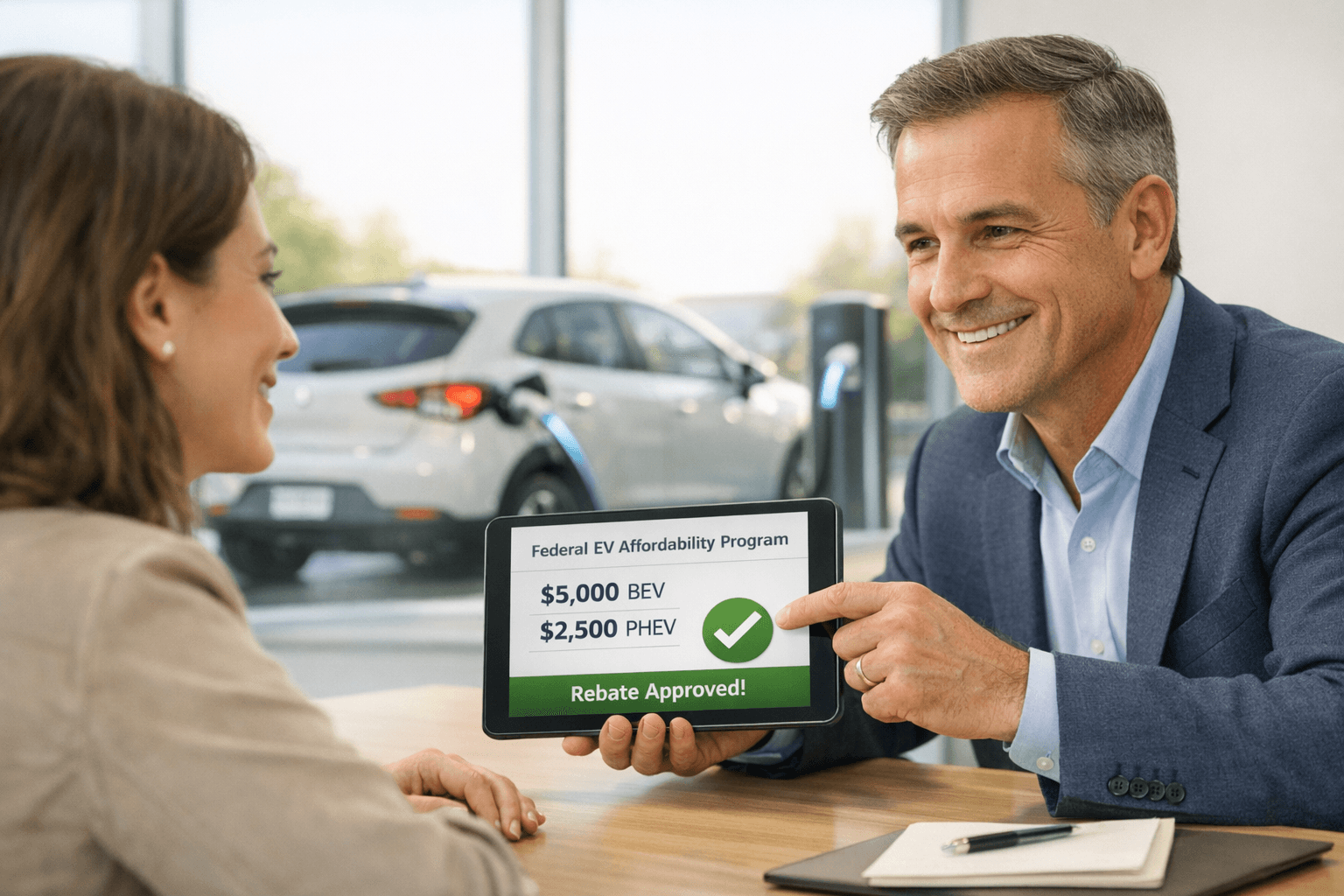
What is Marke Carney new EV rebates?
Mark Carney’s new Electric Vehicle Assistance Program (EVAP), launched on February 16, 2026, offers financial incentives for Canadians to purchase electric vehicles (EVs). Here’s what you need to know:
Rebate Amounts:
Up to $5,000 for battery-electric vehicles (BEVs) and fuel-cell electric vehicles (FCEVs).
Up to $2,500 for plug-in hybrid electric vehicles (PHEVs).
Rebates decrease annually through 2030.
Eligibility:
Available to individuals and businesses across Canada.
Vehicles must be new, priced under $50,000, and manufactured in Canada or countries with free trade agreements.
Canadian-made EVs are exempt from the price cap.
Program Details:
Budget: $2.3 billion over five years.
Goal: Add 840,000 EVs to Canadian roads.
Dealers apply rebates directly at the point of sale, simplifying the process for buyers.
This initiative also includes $1.5 billion for expanding charging infrastructure and aims to boost EV adoption after a decline in sales. Rebates are highest in 2026, encouraging early purchases.
Who Qualifies for the EV Rebate
Buyer Requirements
The EV rebate program is available to both individuals and businesses throughout Canada. There are no income restrictions or household earnings limits for eligibility [7][10]. Individuals can claim one rebate over the five-year program, while businesses are allowed up to 10 rebates, and car-sharing companies can claim up to 50 rebates per year. The rebate is applied directly at the point of sale, making the process straightforward by reducing upfront costs and eliminating extra paperwork [9].
Transport Minister Steve MacKinnon emphasized the program's simplicity, stating, "These point-of-sale incentives will simplify access by reducing paperwork" [11].
In addition to buyer eligibility, vehicles must also meet specific criteria to qualify.
Vehicle Requirements
Only new electric vehicles are eligible for the rebate. This includes Battery Electric Vehicles (BEVs), Fuel Cell Electric Vehicles (FCEVs), and Plug-in Hybrid Electric Vehicles (PHEVs). Demonstration vehicles with less than 6,214 miles that have never been registered are also eligible [8][5][9].
A critical condition for eligibility is the $50,000 final transaction value cap, which includes the vehicle's price along with options, freight, and fees [7]. However, this cap does not apply to Canadian-made EVs, which benefits models like the Dodge Charger EV and the remaining Chrysler Pacifica PHEVs still available at dealerships [9]. Additionally, eligible vehicles must either be manufactured in Canada or imported from countries that have free trade agreements with Canada. This currently excludes U.S.-made models such as Teslas, Chevrolets, and Fords due to ongoing trade disputes [7].
The Canadian EV Rebate: Everything You Need to Know!
Rebate Amounts and Timeline
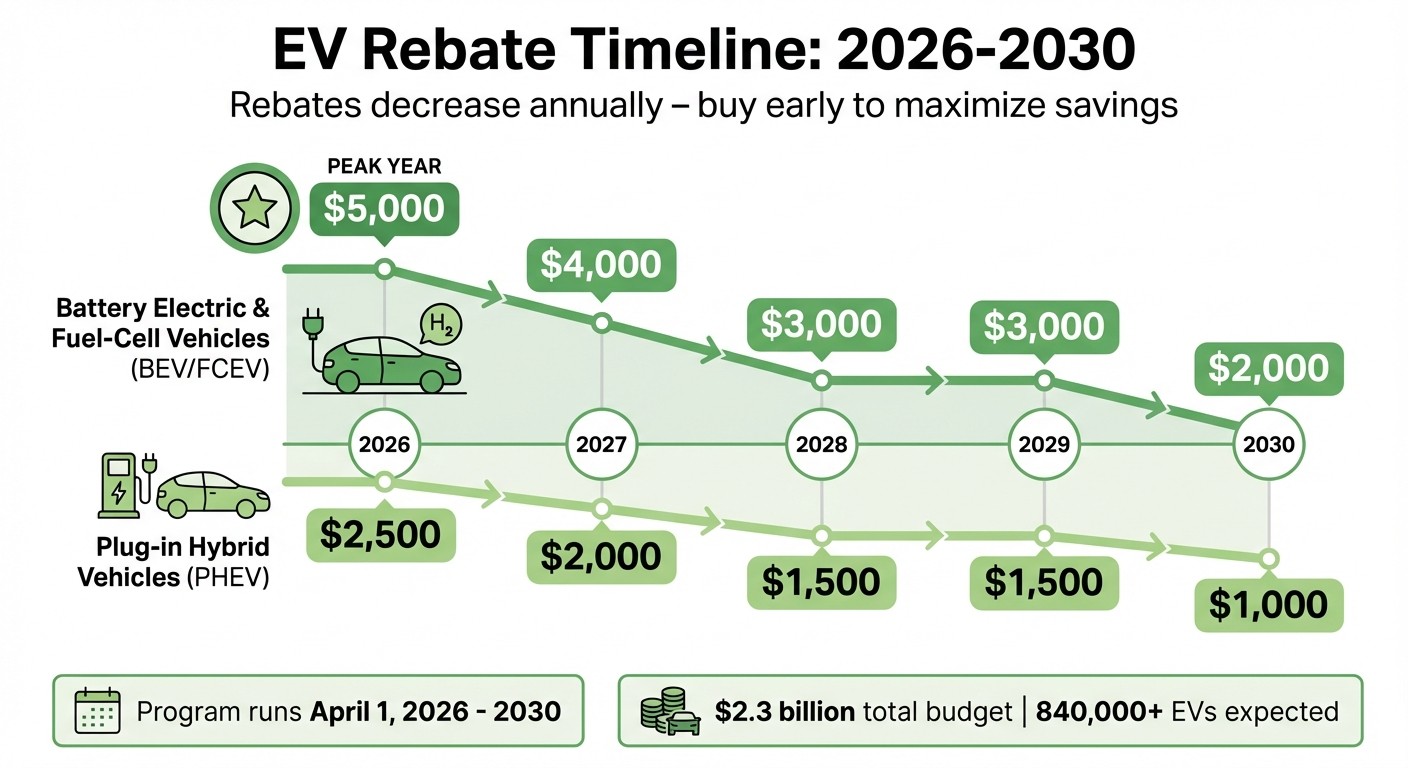
Mark Carney EV Rebate Amounts 2026-2030 Declining Schedule
The EV Affordability Program provides rebates of $5,000 for battery-electric and fuel-cell vehicles and $2,500 for plug-in hybrids starting in 2026 [5][12]. These rebate amounts decrease over a five-year period, reflecting the federal government's plan to gradually phase out subsidies [12][8].
Vehicle Type | 2026 Rebate | 2027 Rebate | 2028 Rebate | 2029 Rebate | 2030 Rebate |
|---|---|---|---|---|---|
Battery Electric & Fuel-Cell (BEV/FCEV) | $5,000 | $4,000 | $3,000 | $3,000 | $2,000 |
Plug-in Hybrid (PHEV) | $2,500 | $2,000 | $1,500 | $1,500 | $1,000 |
Prime Minister Mark Carney outlined the program, saying:
"The new $2.3 billion program will offer individuals and businesses purchase or lease incentives of up to $5,000 for battery electric and fuel cell EVs, and up to $2,500 for plug-in hybrids (PHEVs) with a final transaction value of up to $50,000 on cars made by countries Canada has free trade agreements with" [5].
Potential Cost Savings
This rebate structure directly benefits buyers by reducing upfront costs at the point of sale. For example, purchasing a qualifying 2026 Hyundai Kona EV would save you $5,000 upfront - $3,000 more than the savings you'd see in 2030, when the rebate drops to $2,000 [3]. Similarly, models like the Chevrolet Bolt and Ford Mach E Select trim are eligible for the maximum rebate in 2026 [3].
The declining rebate schedule means acting earlier secures the greatest savings. This approach mirrors the now-ended federal rebate program, which funded 563,313 electric vehicles before concluding in January 2025. After the program ended, EV sales dropped by nearly 60%, highlighting the impact of these incentives [4].
Program Duration and Deadlines
The program officially begins on April 1, 2026, but purchases made as early as February 16, 2026, will qualify once the dealer portal opens on March 31, 2026 [3]. With a commitment of $2.3 billion, the government projects that over 840,000 new EVs will receive rebates during the program's five-year span [5][12][8].
Running through 2030, the program offers a limited window for savings. Since each individual is eligible for only one rebate during this period, purchasing earlier in the program ensures you get the highest benefit. Next, learn how to apply for these rebates.
How to Apply for the Rebate
The application process for this rebate is designed to be simple and stress-free, making electric vehicle (EV) ownership more attainable. You don’t have to deal with any paperwork - the dealer takes care of everything. They apply the discount directly at the time of purchase and later request reimbursement from Transport Canada [14]. This setup minimizes hassle for buyers and aligns with the program's goal of accessibility.
Required Documents
To ensure a smooth process, you’ll need to keep a few documents handy:
Bill of sale or lease agreement
Vehicle Identification Number (VIN)
Itemized pricing sheet [1]
Additionally, ask your dealer to provide written confirmation that the vehicle model and its final transaction value meet the program’s requirements. It’s also important to confirm the vehicle’s manufacturing origin. Vehicles made in countries without a free-trade agreement with Canada - such as China - aren’t eligible for the rebate [13][4].
Submitting Your Application
There’s no separate application for you to complete. The rebate is applied at the point of sale, and the dealer handles everything through a government portal that became available on March 31, 2026 [3]. If you bought an eligible vehicle between February 16, 2026, and March 31, 2026, your rebate was processed once the portal was activated [3].
Before finalizing your purchase, double-check that the dealership is registered with the federal program and able to apply the rebate [7]. Some dealers have faced issues in the past - one reported a $20,000 shortfall due to submission errors - so it’s worth confirming everything is in order [14].
Getting Your Rebate Payment
The rebate is applied instantly at the dealership, reducing the purchase price or lease payment on the spot [7][5]. There’s no waiting period, as the discount is deducted directly at checkout [7][5]. For vehicles purchased between February 16 and March 31, 2026, the rebate was processed retroactively once the dealer portal went live [3]. The dealer handles all reimbursement from the government, ensuring the process remains seamless for buyers.
Using Rebates with Hello Motors Financing
The $5,000 rebate available in 2026 can make a big difference when paired with Hello Motors' flexible payment plans. This incentive reduces the total amount you need to finance, which directly lowers your monthly payments. For instance, financing $5,000 less over a five-year loan at a 6% interest rate could save you roughly $97 per month[1]. This is a game-changer for buyers working with tighter budgets.
Financing Options for All Credit Types
Hello Motors goes beyond rebates to make car ownership accessible by offering financing options tailored to all credit profiles. They work with customers to create personalized plans, helping to reduce the principal from the start. This is especially helpful for the 40% of low-income car buyers who often avoid traditional dealerships[15].
Vehicle Selection and Home Delivery
Hello Motors provides a curated selection of pre-owned vehicles, including electric options that qualify for the rebate. Just make sure the vehicle you choose meets the program's transaction value cap and origin requirements.
Once you've made your selection, Hello Motors delivers the car straight to your doorstep. No need to step into a dealership - convenience at its best.
Combining Rebates with Financing Plans
To maximize your savings, combine the rebate with Hello Motors' financing plans when purchasing or leasing an eligible EV in 2026. Rebates include $5,000 for battery-electric vehicles and $2,500 for plug-in hybrids[16]. Make sure the total transaction value, including fees, stays within the program's cap to secure the full rebate.
Hello Motors also simplifies the rebate process with multilingual support in English, French, Spanish, and Arabic. Their team can assist you with gathering the required documents, such as the bill of sale, VIN, and itemized pricing, ensuring a smooth application process.
Conclusion
Mark Carney's Electric Vehicle Affordability Program aims to make owning an EV easier by offering incentives of up to $5,000 for battery-electric vehicles and $2,500 for plug-in hybrids in 2026 [1][3]. With a budget of $2.3 billion over five years, the program is expected to support the purchase of over 840,000 new EVs, addressing the challenge of high upfront costs [2][8].
The timing of these rebates is critical. Incentives are at their peak in 2026 and gradually decline through 2030, encouraging early adoption [8]. Additionally, a $1.5 billion investment in charging infrastructure tackles practical concerns like accessibility, further building consumer confidence [6][17].
Hello Motors enhances this affordability with flexible financing options for all credit types and home delivery of vehicles. Using the rebate to lower your financed amount can significantly reduce monthly payments. Multilingual support simplifies the rebate application process, making the journey to EV ownership more seamless.
With these incentives and financing options, owning an EV becomes a practical choice. Whether you're considering a battery-electric vehicle or a plug-in hybrid, these tools make the transition to EV ownership both accessible and manageable.