Compare dealer and local shop costs—labor, parts markups, and five-year savings to choose the best repair option.
Published Date:
11 juin 2026
Last Updated:
11 juin 2026

Dealer Repairs vs. Local Shops: Cost Breakdown
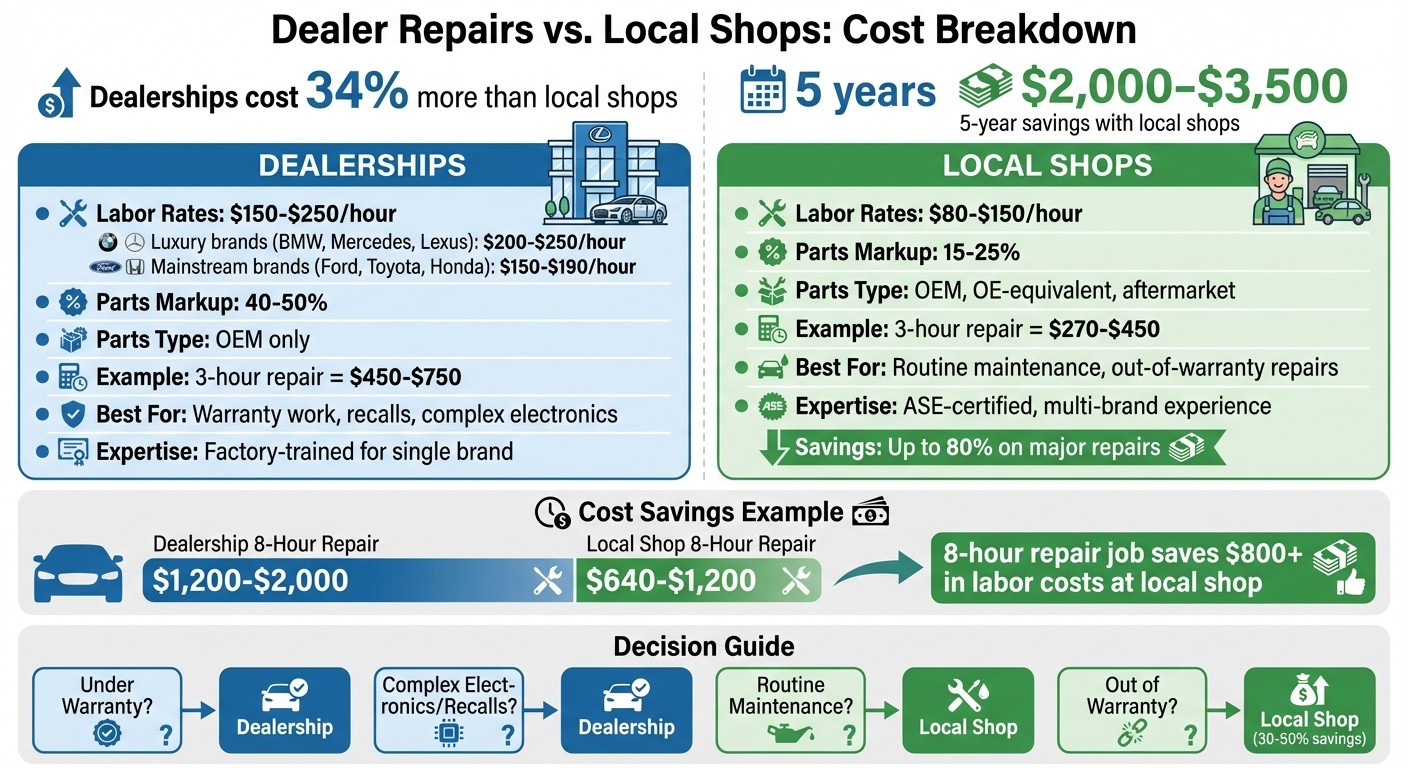
Dealership repairs cost around 34% more than local auto shops. Labor rates at dealerships range from $150 to $250 per hour, while independent shops charge $80 to $150. Parts at dealerships often include a 40–50% markup, compared to 15–25% at local shops. Over five years, switching to a local shop can save you $2,000 to $3,500 on maintenance.
Key Takeaways:
Dealerships: Higher costs due to labor and OEM part markups; ideal for warranty work and complex repairs.
Local Shops: Lower costs, flexible part options, and experienced mechanics for routine maintenance.
Factor | Dealerships | Local Shops |
|---|---|---|
Labor Rates | $150–$250/hour | $80–$150/hour |
Parts Markup | 40–50% | 15–25% |
Best For | Warranty, recalls, complex issues | Routine maintenance, out-of-warranty repairs |
Savings Potential | N/A | Up to 80% on major repairs |
Choose based on your car's warranty status, repair type, and budget.
Dealership vs Local Auto Shop Repair Costs Comparison
1. Dealership Repairs
Labor Costs
Dealerships charge labor rates ranging from $150 to $250 per hour, depending on the brand. Luxury brands like BMW, Mercedes, and Lexus typically fall in the $200–$250 per hour range, while mainstream brands such as Ford, Toyota, and Honda charge between $150 and $190 per hour [2]. These higher rates are driven by technician salaries, operational costs, and administrative overhead [1][4].
The pricing gap becomes especially noticeable on larger repair jobs. For example:
"A repair booked at 3.0 hours labor costs $450-$750 at a dealer versus $270-$450 at an independent" [2].
Dealerships often stick to a "safe replacement path", meaning they replace entire assemblies rather than diagnosing and fixing specific components. While this approach minimizes warranty claims for the dealer, it can significantly increase costs for customers [5]. Additional charges for diagnostics and full part replacements further inflate the final bill [4].
These labor costs are just one piece of the puzzle - parts pricing also plays a major role in the overall expense.
Parts Pricing
Dealerships exclusively use OEM (Original Equipment Manufacturer) parts and charge the full manufacturer list price. After purchasing parts at wholesale prices - typically 30–40% below list - they add a markup of 40–50% [1][2].
This practice can lead to steep price differences. For instance, a dealership might charge $950 for an OEM AC compressor, while an independent shop could quote $480 for a remanufactured version from the same manufacturer [2].
Although the cost of parts is higher, dealerships argue that their specialized training and warranty protections justify the added expense.
Warranty and Expertise
Dealerships often defend their higher costs by pointing to their expertise and warranty coverage. Their technicians undergo factory training and use proprietary diagnostic tools, such as Ford IDS or Toyota Techstream - equipment that independent shops generally can't access [2][5]. This specialized knowledge is especially valuable for handling advanced driver assistance systems (ADAS), complex infotainment issues, and module programming.
As John Ibbotson, Chief Mechanic at Consumer Reports, puts it:
"The dealership's expertise in its own cars justifies the higher cost of labor for these repairs" [6].
Another advantage is warranty work. Repairs covered under factory or extended warranties are typically free of charge [2]. Additionally, dealerships offer nationwide warranty coverage for their repairs, meaning any dealership of the same brand will honor the work [7][8]. For vehicles still under warranty or those requiring intricate software updates, dealerships remain a practical, albeit more expensive, option.
2. Local Auto Shops
Labor Costs
Local auto shops often provide a more budget-friendly alternative to dealerships when it comes to labor. While dealerships typically charge $150 to $250 per hour, independent shops offer rates between $80 and $150 per hour - a significant difference [1][2]. These lower rates are largely due to reduced overhead; local shops don't have to maintain large administrative teams or cover the costs associated with high-end facilities and branding [1].
For extensive repairs, the savings can be substantial. For instance, an 8-hour repair job could save you over $800 in labor costs compared to a dealership [2]. Repairs that require significant labor, like transmission or suspension work, can cost up to 80% less at a local shop [1]. Additionally, independent mechanics often focus on fixing specific components rather than replacing entire assemblies, further cutting down both labor time and parts expenses [5].
Parts Pricing
Another area where local shops shine is in parts pricing. Unlike dealerships that rely solely on OEM parts at full price, independent mechanics have more sourcing options. They can use OE-equivalent parts - made by the same manufacturers but sold under different packaging - or aftermarket parts, which are typically 20–40% cheaper [2].
Moreover, the markup on parts at local shops is generally 15–25%, much lower than the 40–50% markup commonly seen at dealerships [1]. This flexibility and transparency in sourcing parts can lead to noticeable savings for vehicle owners.
Warranty and Expertise
Independent shops employ highly skilled technicians, often ASE-certified, with years - even decades - of experience [1]. Unlike dealership mechanics who typically specialize in a single brand, local shop technicians work on a wide variety of makes and models, giving them a broader range of expertise [1]. Many modern independent shops also invest in advanced diagnostic tools, such as Autel and Snap-on scanners, which provide 95% diagnostic coverage [2].
When it comes to warranties, independent shops hold their own. They offer warranties on both labor and parts, and under the Magnuson-Moss Warranty Act, having your car serviced at an independent shop won't void your manufacturer's warranty as long as the work meets required specifications [1]. John Ibbotson, Chief Mechanic at Consumer Reports, emphasizes the value of building a relationship with a trusted local shop:
"Loyalty to one shop is most often rewarded with technicians who know your particular vehicle, and with an honest appraisal of what's needed" [6].
Overall Value
Taking into account savings on both labor and parts, independent shops generally charge 30–50% less than dealerships for maintenance and repairs [2][4]. Over five years, switching from dealership services to a local shop could save you anywhere from $2,000 to $3,500 on routine maintenance alone [1].
While local shops may not offer perks like loaner vehicles or same-day service [3], they excel in delivering reliable, cost-efficient solutions for routine maintenance and repairs. Whether you need work on brakes, batteries, fluids, or suspension, independent shops provide professional results without breaking the bank.
Main Dealer vs Independent Garage – You’re Wasting Money If You Don’t Watch This.
Pros and Cons
When weighing your options for car repairs, it's important to consider the advantages and drawbacks of both dealerships and local auto shops. Dealerships often provide perks like loaner vehicles, same-day service, and complimentary car washes. For those who rely on these conveniences, the higher costs might feel justified.
On the other hand, local shops can save you a significant amount of money on the same repairs. As John Goreham of Car Talk puts it:
"A trusted local shop is almost always the best value for car repair. Dealers often charge dramatically more money to do the same work." [3]
Here's a breakdown of key factors to consider:
Factor | Dealership Repairs | Local Auto Shops |
|---|---|---|
Average Cost | 34% higher [1] | Much lower - up to 80% savings [1] |
Labor Rates | $150–$250/hour [2] | $80–$150/hour [2] |
Parts Used | OEM only (40–50% markup) [1] | OEM, OE-equivalent, or aftermarket (15–25% markup) [1] |
Expertise | Factory-trained for a single brand [8] | ASE-certified with experience across multiple brands [1] |
Convenience | Loaner cars, shuttle service, quick turnaround [8] | Direct access to your mechanic, personalized service [8] |
Best For | Warranty work, recalls, complex electronics [6] | Routine maintenance and out-of-warranty repairs [6] |
Dealership technicians are specialists trained specifically for one brand, with access to exclusive diagnostic tools. Local shop mechanics, however, are typically ASE-certified and have 10–20+ years of experience working on a variety of brands and systems.
If you're deciding where to take your car, think about the type of repair you need. Dealerships are ideal for warranty work, recalls, and complex electronic issues like ADAS alignments or infotainment system glitches. For routine maintenance - like brakes, oil changes, or suspension repairs - local shops often deliver the same quality at a fraction of the cost, with potential savings of 30–50%.
Conclusion
Dealership repairs typically cost about 34% more than independent shops, with labor rates ranging from $150–$250 per hour at dealerships versus $80–$150 at local mechanics [1][2]. Over five years, opting for an independent shop for routine maintenance can save you anywhere from $2,000 to $3,500, as these shops often offer 40–60% savings on standard services like oil changes and brake work [1][2].
When deciding where to take your car, consider three main factors: warranty status, type of repair, and your budget. If your vehicle is still under warranty, requires a recall repair, or needs manufacturer-specific services like proprietary software updates or key programming, the dealership is usually the better option. These services are often covered at no additional cost [2][5].
Once your warranty expires, independent shops become a more cost-effective choice. For routine maintenance tasks - such as fluid flushes, brake services, and oil changes - local mechanics can deliver the same quality at a lower price, without sacrificing technical expertise [2].
As QuoteChecker.ai advises:
"If the repair is covered under warranty, recall, or TSB - go to the dealer. For everything else on an out-of-warranty vehicle, get an independent quote first and compare." [2]
Additionally, the Magnuson-Moss Warranty Act protects your right to use a trusted independent shop for routine maintenance without voiding your manufacturer’s warranty [1][5].
Ultimately, it comes down to balancing cost with necessity. Dealerships provide convenience and specialized tools but charge a premium, while independent shops offer reliable service at a fraction of the cost. Your decision should align with your car's warranty status and the type of service it needs.