
Gas cars still hold resale value better - EVs average ~58.8% five-year depreciation vs ~45.6% for gas; battery health and range matter.
Published Date:
Jun 19, 2026
Last Updated:
Jun 19, 2026

Electric vs Gas Cars: Resale Value Trends
If resale value is your top concern, gas cars still win. In the data here, EVs lose about 58.8% of their value over five years, while the average across all vehicles is about 45.6%.
Here’s the short version: if I want the safer bet for trade-in or resale, I’d lean toward a gas SUV or truck from a reliable dealership. If I’m open to an EV, I’d focus on a 3- to 5-year-old model, check the battery report, and stick with one that has 250+ miles of range.
What matters most in this comparison:
Gas cars usually have steadier resale prices
EVs often drop faster because of tax credits, price cuts, and battery concerns
Battery health has a big effect on used EV pricing
Longer-range EVs are doing better than older short-range models
Trucks and SUVs still tend to hold value best
Quick Comparison
Factor | EVs | Gas Cars |
|---|---|---|
5-year depreciation | 58.8% | 45.6% average |
Main resale concern | Battery condition, range, software aging | Mileage, wear, repair history |
Buyer confidence | Mixed, but getting better | More stable |
Best-used sweet spot | 3–5 years old with battery records | Strong across many ages |
Resale strength today | Better on newer long-range models | Still ahead overall |
So if you’re buying with the end in mind, the simple takeaway is this: gas cars still hold value better, but some used EVs can make sense if the biggest drop has already happened.
Market Snapshot: EV and Gas Car Resale Trends Today
In 2026, a wave of off-lease EVs is putting pressure on used prices. At the same time, longer-range models are starting to bounce back. That pressure is also beginning to change as newer EVs reach the market.
Why Gas Vehicles Still Offer a More Stable Resale Baseline
Gas cars, especially trucks and SUVs, have one big advantage: history. Lenders, dealers, and buyers already know, with decent confidence, what a well-kept Honda CR-V or Toyota Tacoma will likely be worth in three or five years. That long track record helps keep used prices steadier.
Demand plays a big part too. There are still far more buyers who feel comfortable with gasoline vehicles, and that broad buyer pool helps prevent sharp resale drops.
Some models show this clearly:
The Toyota Tacoma TRD holds about 68% of its value after five years [3].
The Toyota 4Runner SR5 holds about 67% after five years [3].
Another piece of the puzzle is battery risk. Used gas-car buyers don't have to factor in a possible $8,000 to $20,000+ battery replacement bill [1]. That worry hangs over many used EV purchases, and gas vehicles simply don't carry it in the same way.
Why Newer EVs Are Regaining Some Resale Strength
The used EV market is starting to sort itself out. Not all EVs age the same in the resale market, and buyers are paying close attention to range.
Older EVs with 150 to 220 miles of range tend to lose value much faster than newer models rated for 250 to 320+ miles [1][2]. That's not hard to understand. If you're buying used, extra range gives you more breathing room, and it eases some of the range anxiety that still shapes buying decisions.
Battery health is also looking better than many shoppers once feared. Most modern EV battery packs lose only about 2% to 3% of capacity per year under normal use, and a battery that still has 90% to 95% capacity usually doesn't hurt resale much [1]. That matters because it shifts the conversation from all EVs lose value fast to which EVs hold up well?
Some popular nameplates, including certain Tesla and Hyundai Ioniq models, are doing better on resale than older short-range compliance cars [1]. That split from one model to another helps explain why gas vehicles still set the baseline for resale, even as newer EVs start to gain back some ground.
Gas Cars and Resale Value: Why They Usually Hold Up Better
Gas vehicles usually lose value more slowly, and their price drops tend to be easier to predict than EVs. A big reason is simple: buyers understand them. The costs, the upkeep, and the day-to-day tradeoffs feel familiar. That makes used gas cars easier to price and easier to sell.
Steady Demand in the Used Car Market
Gas cars keep a bigger resale audience because most buyers already know what ownership looks like. They know how refueling works, what maintenance may cost, and what kind of driving experience to expect. Fueling is also available almost everywhere [1], which helps gas vehicles reach more shoppers and supports used prices over time.
You can see this in full-size gas pickups. After five years, they typically retain about 60% of their value [1].
Slower Technology Shifts and Lower Buyer Risk
Used buyers also run into fewer question marks with gas cars. Older gas models don't feel outdated as fast because the tech changes at a slower pace. As a result, buyers often don't cut their value as sharply as they do with older EVs.
Gas cars also sidestep two big issues that can drag down used-EV prices:
New-EV tax credits can make brand-new EVs look more appealing next to used ones [1]
Gas cars don't carry the same battery replacement risk [1]
Those same issues help explain why EV resale still trails, even as newer models get better.
Electric Cars and Resale Value: Faster Depreciation but a Better Outlook
Compared with the more stable gas-car market, EV resale value depends a lot more on range, battery health, and the price of new models. In general, EVs have lost value faster than gas cars, though the gap changes depending on the model and model year.
What Has Hurt EV Resale Values
Federal tax credits and repeated cuts to new-EV prices have dragged down used prices, often by thousands of dollars [1][5]. Tesla’s price cuts from 2022 to 2024 are the clearest case of this [6][7].
Tech changes have also made things tougher. When a new model offers more range for the same money, older EVs can look old in a hurry. As Ralph Mureti, a licensed appraiser at Appraisal Engine, noted:
A 40- to 50-mile range gain at the same price can make older EVs look outdated fast [5].
Battery replacement cost is another big factor. Replacing a pack can run from $8,000 to more than $20,000, which makes many used-EV shoppers nervous, especially when a car is close to the end of its battery warranty [1]. That pressure has hit early short-range EVs the most, including models with about 64% depreciation over five years [1].
Even so, newer EVs are starting to move away from those weaker resale trends.
Where EV Resale Values Are Getting Stronger
The EVs holding up best now are usually newer models with more range, better charging speeds, and stronger battery records. That shift is starting to show in resale numbers.
The Tesla Model 3 and Model Y now lose about 55% to 60% of their value over five years [1]. That’s still a steep drop, but it’s better than what many older EVs posted. The Porsche Taycan has posted three-year losses under 40%, which puts it ahead of many premium gas sedans on resale [8]. Resale for the Hyundai Ioniq 5 and Kia EV6 has also improved, helped by fast charging and solid buyer demand [7].
Battery-condition data is helping too. When a used EV comes with proof that the battery is still in good shape, its value can be 10% to 15% higher [7].
What Drives the Difference and Which Type Holds Value Better
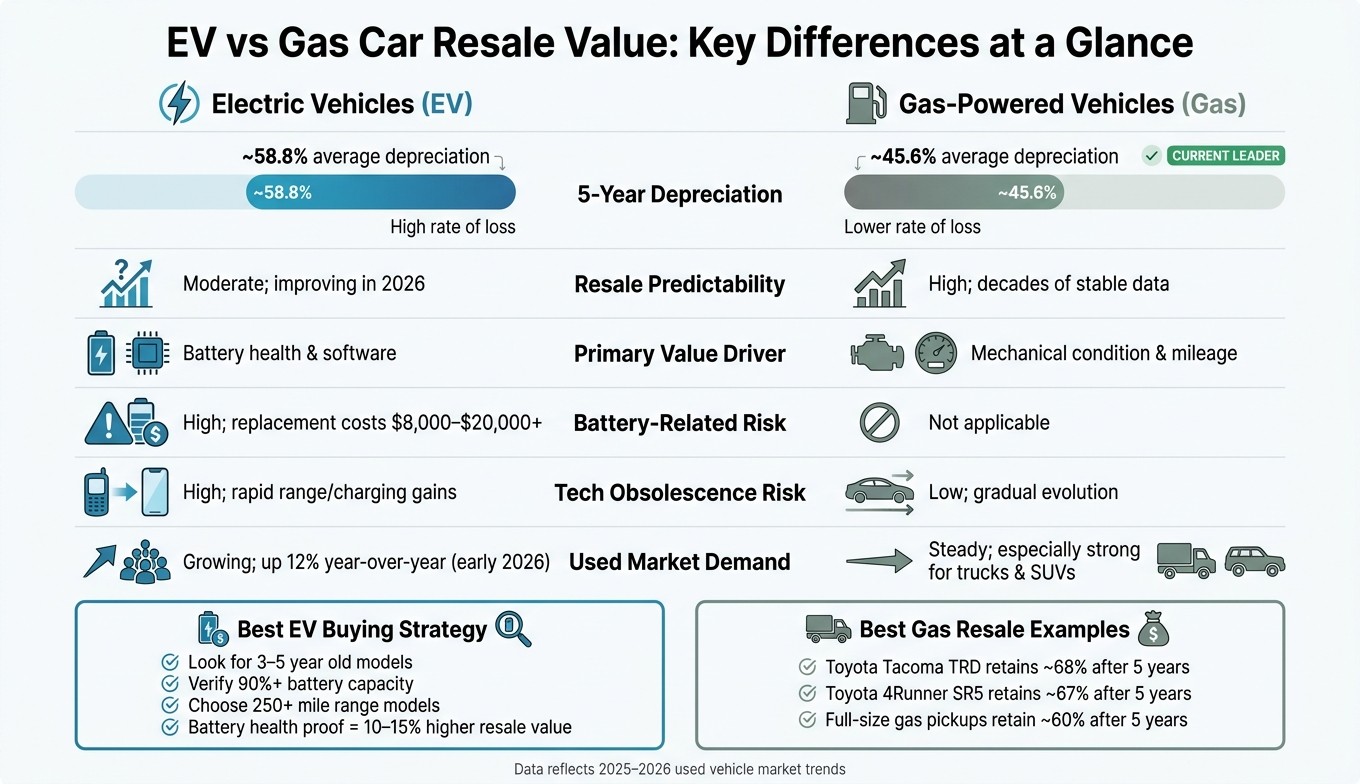
EV vs Gas Car Resale Value: 5-Year Depreciation Comparison
Several forces shape how fast a vehicle loses value, and gas cars and EVs are affected by different ones. For gas vehicles, the main drivers are mechanical condition, mileage, and steady buyer demand. For EVs, it gets a bit more layered: battery health, tech update cycles, federal incentives, and charging access all play a part.
Federal and state tax credits push down the price of new EVs, which then puts pressure on used EV prices [1][5]. And when EV tech moves fast, that pressure tends to hit even harder.
Fast EV tech cycles can make older models feel out of date sooner [1][5]. Lower day-to-day costs help EVs draw interest, but that alone doesn't cancel out steeper depreciation.
Side-by-Side Resale Value Comparison
Here’s how those factors show up in resale data.
Factor | Electric Vehicles | Gas-Powered Vehicles |
|---|---|---|
5-Year Depreciation | ~58.8% average [1] | ~45.6% average [1] |
Resale Predictability | Moderate; improving in 2026 [6] | High; decades of stable data [4] |
Primary Value Driver | Battery health & software [9] | Mechanical condition & mileage [9] |
Battery-Related Risk | High; replacement costs $8,000–$20,000+ [1] | Not applicable |
Tech Obsolescence Risk | High; rapid range/charging gains [5] | Low; gradual evolution [5] |
Used Market Demand | Growing; up 12% year-over-year in early 2026 [6] | Steady; especially strong for trucks and SUVs [1] |
What the Comparison Means for Buyers
Gas cars still hold value better today, especially trucks and SUVs. Those vehicles tend to land in the 38%–45% range for five-year depreciation [1]. If resale protection is your top concern, that’s still what the numbers favor.
But your own driving habits can change the picture. If you drive 10,000–15,000 miles per year, can charge at home, and plan to keep the vehicle for five years or more, a used EV may still save you more overall even with steeper depreciation. That comes from lower fuel and maintenance costs [1][4].
For many shoppers, the sweet spot in the used EV market is a model that’s 3–5 years old. The sharpest drop in value has often already happened, and battery warranty coverage may still be in place [1][7]. Before you browse inventory and buy, get a third-party battery health report. A battery pack with 90%+ capacity is usually fine, while one at 75%–80% can cut into both daily use and resale value in a big way [1].
Conclusion: Key Takeaways on EV vs Gas Resale Value
Put simply, gas vehicles still have the edge when it comes to resale. Trucks and SUVs with gas engines tend to hold their value better, usually losing about 38%–41% over five years, compared with 58.8% for EVs [1].
That said, the gap isn't as wide as it used to be. Newer EVs are doing better on the used market, and models with 250+ miles of real-world range are starting to close the distance with gas cars [2].
At the same time, EV resale can swing a lot from one model to the next. Range matters. Battery condition matters even more. In fact, battery health is still the main driver of used EV resale value [1][6].
For buyers, the takeaway is pretty simple: gas cars still lead in resale stability, but a well-picked EV can be a smart buy once the steepest drop in value is already out of the way, especially if the battery health has been verified.