
Alternator repair, alternator symptoms, charging system, alternator testing, voltage regulator, serpentine belt, alternator replacement, alternator cost
Published Date:
Jun 19, 2026
Last Updated:
Jun 19, 2026

Alternator Repairs: Common Issues Explained
When your car’s alternator fails, it can lead to a dead battery, flickering lights, or even a stalled engine. The alternator powers your vehicle’s electrical systems and recharges the battery while driving. Common issues include low or no charging output, overcharging, and worn bearings, which can cause grinding noises or voltage problems. Symptoms like dim headlights, slow power windows, or dashboard warning lights often signal trouble.
Basic checks, like using a multimeter to test voltage (13.5–14.5V while running), can help diagnose the problem. Repairs typically cost $400–$1,000, depending on your vehicle and whether you choose DIY or professional service. Regular maintenance, such as inspecting the serpentine belt and keeping battery terminals clean, can extend your alternator’s lifespan. If issues persist, consult a mechanic to avoid further damage.
How the Alternator and Charging System Work
Key Parts of the Charging System
The charging system relies on five main components that work together while the engine is running:
Component | Function |
|---|---|
Alternator | Produces electricity when the engine is running [3] |
Battery | Stores energy to start the engine and stabilizes the electrical system [7] |
Voltage Regulator | Regulates the alternator's output to keep voltage within a safe range (13.8–14.4V) [9][5] |
Serpentine Belt | Transfers power from the crankshaft to the alternator pulley [7][8] |
Wiring/Grounds | Delivers current to the battery and provides a return path via the vehicle's frame [7][5] |
Some vehicles also include a fusible link, a high-amperage fuse between the alternator and battery. If this link blows, the alternator won't charge the battery, even if it’s functioning [5].
How the Alternator Produces Electricity
The alternator’s job starts with the engine. When the engine runs, the serpentine belt spins the alternator’s rotor, creating a magnetic field. As this rotor moves past the stator (a set of stationary wire windings), it generates alternating current (AC) through electromagnetic induction [3][8].
Since cars require direct current (DC), the alternator has a rectifier that converts AC to DC [8][9]. The voltage regulator then adjusts the rotor’s magnetic field to ensure the output stays within the required voltage range [9][5].
"The diode bridge, or rectifier assembly... must convert the alternating current (AC) produced by the stator into direct current (DC) that the car's electrical system uses." - Engineer Fix [9]
If just one diode in the rectifier fails, the alternator’s power output can drop by as much as one-third [9]. This explains why a partially failing alternator might still work but fail to meet the system’s full energy demands. Once converted, the electricity is ready for the battery and other components.
How the Alternator and Battery Work Together
The alternator and battery form a team. The battery provides the initial power to start the engine. Once the engine is running, the alternator takes over, powering the vehicle’s electrical systems and recharging the battery [7].
"The alternator's three critical jobs: 1. Generates electricity while the engine runs... 2. Charges your battery to replace power used for starting 3. Powers all electrical systems." - Fernando Garcia, ASE Certified Technician [10]
A properly functioning alternator keeps the system voltage between 13.8V and 14.4V while the engine runs. If the voltage drops below 13.5V, the battery begins to lose charge instead of gaining it. On the other hand, voltages above 15V usually signal a faulty voltage regulator [10]. These voltage thresholds are essential for diagnosing alternator issues.
Common Alternator Problems and Their Symptoms
Low or No Charging Output
Undercharging often happens when components like worn brushes, damaged slip rings, or faulty rectifier diodes disrupt power production [4][12]. Essentially, the alternator may still operate but can't generate enough electricity to support the vehicle's systems.
You might notice dim headlights at idle, slow-moving power windows, or a battery warning light on the dashboard [4]. In more severe cases, like a snapped belt or a complete internal failure, the alternator won't charge at all. Once the battery's energy runs out - typically within 30 to 60 minutes - the engine will stall [8].
"A bad alternator is frequently misdiagnosed as a bad battery - and vice versa." - Jason Thompson, Journalist, Carvira [8]
Overcharging and Voltage Spikes
Overcharging, while less frequent, can cause serious damage. This issue is almost always linked to a failed voltage regulator, which pushes the alternator's output beyond 15 volts [11][12]. Modern vehicles usually have the regulator built into the alternator, so if it fails, you'll likely need to replace the entire unit.
Signs of overcharging include boiling battery fluid, which can cause swelling or leaks [6]. You might also deal with frequent headlight bulb burnouts or notice a burning smell from under the hood [4]. Ignoring these signs can lead to damage to critical electronics, such as the engine control module.
Worn Bearings and Grinding Noises
Over time, alternator bearings wear out, often causing whining, growling, or grinding sounds that get louder as the engine revs higher [2]. These noises are a clear sign that the alternator is under mechanical strain.
If a bearing fully seizes, the alternator's pulley can lock up, putting extra stress on the serpentine belt. In extreme cases, the belt may snap, leading to an immediate loss of essential functions like engine cooling and power steering [2]. Addressing early noise issues is vital because they can quickly escalate into overheating problems.
"If you continue driving with a bad alternator, you can damage crucial electrical components like the water pump, power steering, and fuel pump." - NAPA Canada [2]
Before blaming the alternator, it's smart to check the serpentine belt. A loose, cracked, or glazed belt can mimic these symptoms, while an overly tight belt can speed up bearing wear [4].
Spotting these symptoms early can save you from more extensive repairs down the line.
How to Diagnose Alternator Issues
Early Warning Signs to Watch For
Alternator problems often give you clues before they escalate. One of the first indicators is the battery warning light, which signals that the charging system isn't maintaining the correct voltage [4]. Another common sign is headlights that dim when the engine idles but brighten when you rev it - this typically points to an alternator struggling to keep up [11].
Other symptoms include slow-moving power windows, a radio that cuts in and out, or sluggish accessories. If you notice a burning rubber smell, it could mean the serpentine belt is slipping, while burning odors from under the hood might suggest overheating. These are all signs to start troubleshooting and confirm if the alternator is at fault. With a few basic tools, you can quickly check its performance at home.
Basic Checks You Can Do at Home
A digital multimeter is a handy tool for testing your alternator. First, with the engine off, place the probes on the battery terminals. A healthy battery should show a reading of 12.6 volts or higher [11]. Next, start the engine. If the alternator is functioning, the voltage should rise to between 13.5V and 14.5V [11].
"Checking the alternator is a relatively easy process. Alternator charging voltage can be checked using a digital multimeter at the battery terminals." - Mia Bevacqua, ASE Master, RepairPal [1]
Here’s a quick guide to interpreting your multimeter readings:
Multimeter Reading (Engine Running) | What It Means | Recommended Action |
|---|---|---|
13.5V – 14.5V | Normal charging | No action needed |
Below 13.5V | Undercharging | Check belt tension; alternator may need replacement |
Above 15.0V | Overcharging | Inspect or replace the voltage regulator |
12.6V or less | No output | Check battery connections and belt condition |
Before replacing parts, inspect the serpentine belt for signs of wear like cracks, glazing, or slack - a slipping belt can mimic alternator failure [4]. Also, ensure the battery terminals are clean and tightly secured, as corrosion can distort your readings [4]. If your tests suggest an issue, it’s time to consult a professional.
When to Take Your Car to a Mechanic
If your at-home checks reveal serious symptoms, it’s best to involve a mechanic. For example, if your car stalls while driving, that’s a critical safety concern since a failing alternator could cut power to essential systems [11]. Grinding noises or visible smoke are also red flags - turn off the engine immediately to prevent further damage [11].
Mechanics have tools and techniques that go beyond basic checks. They can perform load tests to evaluate how the alternator and battery perform under real electrical demands [1]. They might also use an inductive probe to measure amperage output or scan the Engine Control Module for alternator-related problems, especially in newer vehicles [1]. If your alternator is failing, professional diagnostics can ensure the right solution.
Alternator Testing & Repair (EVERYTHING You Need To Know!)
Repair Options, Costs, and Maintenance Tips
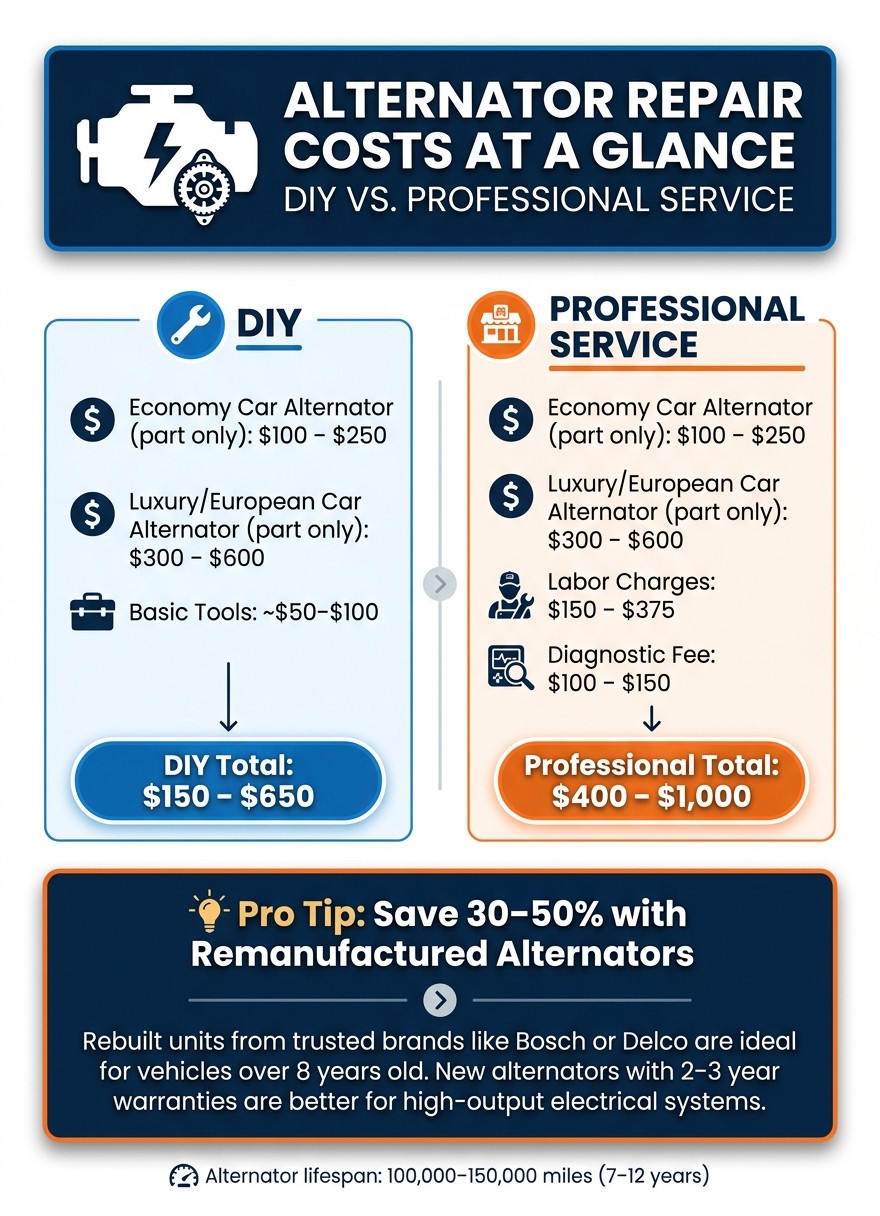
Alternator Repair Costs: DIY vs Professional – Full Breakdown
Common Repair Approaches
Once you've confirmed alternator problems, there are a few ways to tackle the issue.
These days, replacing the entire alternator is often the go-to solution. It’s simpler and usually more affordable than trying to rebuild the unit. As Mia Bevacqua, ASE Master Technician, explains:
"In the past, alternators were repaired and rebuilt. But nowadays, they are inexpensive and typically replaced." [1]
That said, not every charging problem requires a full alternator replacement. Sometimes, a loose or worn drive belt is the real culprit and just needs to be adjusted or replaced. In older vehicles, a failing voltage regulator could also be swapped out independently. However, in many modern cars, the voltage regulator is part of the Engine Control Module (ECM), meaning a software diagnostic or update might be necessary. Additionally, technicians often test and charge the battery before installing a new alternator. This step is crucial because a bad battery can strain the alternator, potentially causing it to fail prematurely [1].
Typical Repair Costs and What Affects Them
The cost of alternator repairs depends on your vehicle type, the parts involved, and whether you’re doing it yourself or hiring a professional. Here's a general idea of what to expect:
Service | Cost Range ($) |
|---|---|
DIY total (parts + basic tools) | $150 – $650 |
Professional total (parts + labor) | $400 – $1,000 |
Labor charges (shop) | $150 – $375 |
Economy car alternator (part only) | $100 – $250 |
Luxury/European car alternator (part only) | $300 – $600 |
Diagnostic fee | $100 – $150 |
For instance, replacing an alternator on a Ford F-150 might involve lower labor costs compared to a luxury car, which often requires more time due to additional component removal [13]. Another factor is whether you choose a new or remanufactured alternator. Rebuilt units from trusted brands like Bosch or Delco can save you 30% to 50% compared to new ones. These are a smart option for cars over eight years old. On the other hand, new alternators, which usually come with warranties lasting two to three years, are better suited for vehicles with high-output electrical systems [13].
Regular maintenance can also help you avoid costly repairs down the road.
How to Make Your Alternator Last Longer
Want to extend the life of your alternator? Here are some tips to keep it running smoothly. Alternators generally last between 100,000 and 150,000 miles, which translates to about 7 to 12 years [13][14].
Check the serpentine belt regularly for cracks, fraying, or glazing. Make sure it doesn’t deflect more than ½ inch.
Keep battery terminals clean and free of corrosion, as buildup forces the alternator to work harder than necessary.
Avoid using high-power features like heated seats or rear defrosters when the engine is off.
Once your vehicle surpasses 135,000 miles, have the charging system inspected periodically to catch wear and tear early [15].
Taking these steps can help you get the most out of your alternator and reduce the chances of unexpected breakdowns.
Conclusion: Keeping Alternator Problems in Check
Alternator issues don’t usually appear out of nowhere. They tend to creep up - starting with dimming headlights or slow-moving power windows - until one day, your car just won’t start. Spotting these early warning signs can save you from a sudden breakdown and prevent damage to other key parts like the water pump, power steering, or fuel pump [11].
To keep your alternator in good shape, try a few basic maintenance steps: check the voltage (it should read between 13.5 and 14.8 volts when idling), inspect the serpentine belt for wear, and clean the battery terminals regularly. These simple checks can help you determine when it’s time to call in a professional.
If you do need repairs, professional services typically range from $250 to $800 [4].
On the other hand, if you’re shopping for a used car and want to avoid these hassles altogether, Hello Motors offers a variety of pre-owned vehicles with flexible financing options for all credit situations. Plus, they deliver the car right to your door. Taking a proactive approach like this not only reduces the risk of unexpected breakdowns but also helps extend your car’s lifespan.