
CVT-equipped used cars save fuel but demand strict maintenance—missing service records can mean expensive transmission repairs.
Published Date:
Jun 11, 2026
Last Updated:
Jun 11, 2026
Used Cars with CVT: Buyer Tips
When buying a used car with a CVT (Continuously Variable Transmission), there are key factors to consider. CVTs offer smoother acceleration and better fuel efficiency, but they can be expensive to repair and require diligent maintenance. Here’s what you need to know:
Pros: Improved fuel economy (up to 5% better than automatics), smooth driving experience, lightweight design, and efficient power delivery.
Cons: High repair costs ($3,000–$8,000), shorter lifespan (often needs attention at ~100,000 miles), and maintenance sensitivity (fluid changes are critical).
What to Check: Look for signs of wear like RPM fluctuations, engagement delays, unusual noises, burnt fluid smells, or dashboard warnings.
Maintenance Records: Ensure fluid changes every 30,000 miles, correct fluid use, and regular inspections.
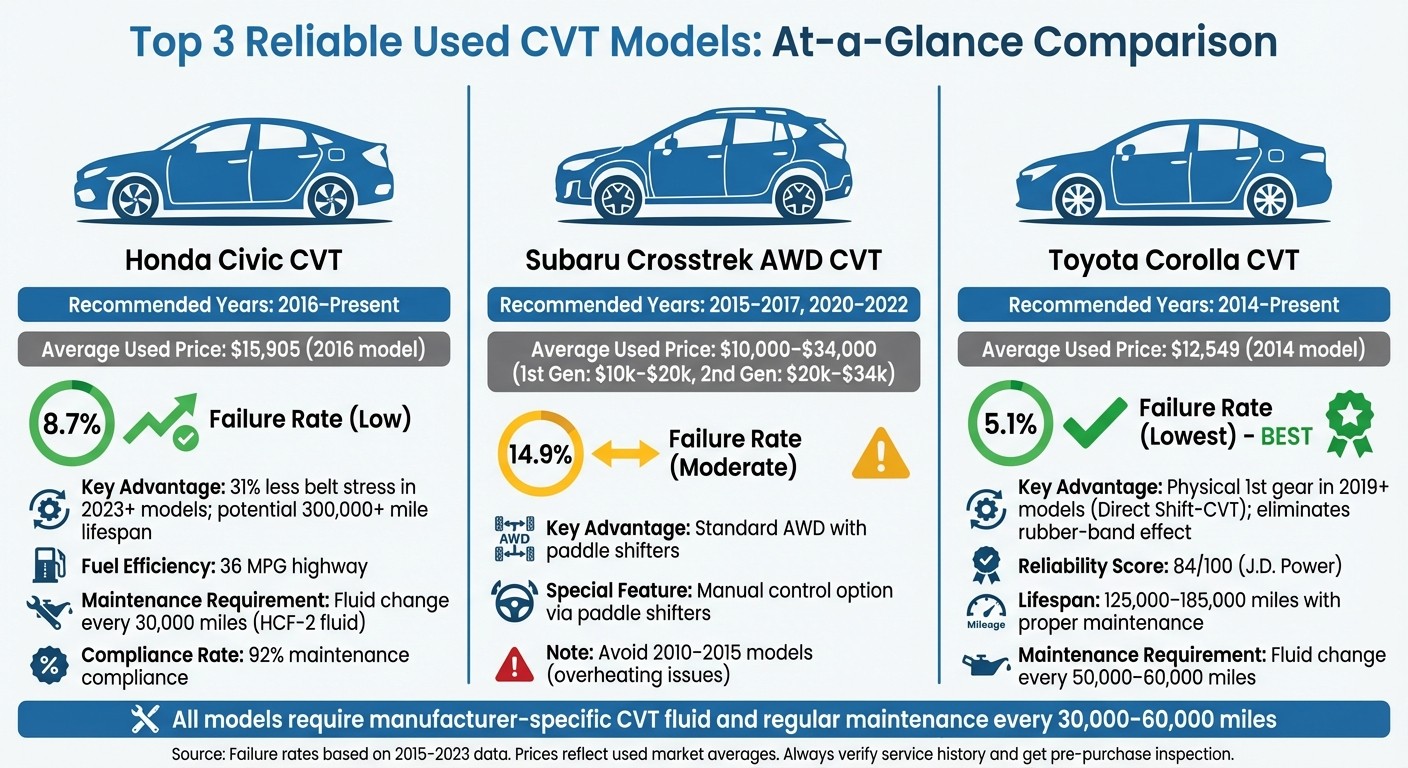
Reliable Models: Honda Civic (2016+), Subaru Crosstrek (2015–2017, 2020–2022), and Toyota Corolla (2014+). These have lower failure rates and better longevity.
Maintenance Tips: Stick to frequent fluid changes, monitor the cooling system, and avoid aggressive driving to extend the CVT's life.
Quick Comparison of Reliable Used CVTs:
Model | Recommended Years | Price Range | Failure Rate | Key Feature |
|---|---|---|---|---|
Honda Civic | 2016–Present | ~$15,905 (2016) | 8.7% | Low belt stress, potential 300k+ mile lifespan |
Subaru Crosstrek | 2015–2017, 2020–2022 | $10k–$34k | 14.9% | AWD with paddle shifters |
Toyota Corolla | 2014–Present | ~$12,549 (2014) | 5.1% | Direct Shift-CVT for smoother acceleration |
If you’re considering a used CVT vehicle, prioritize models with a strong service history and invest in a pre-purchase inspection to avoid costly surprises.
7 Crucial Tips BEFORE Buying a USED CVT Car!
What Is a CVT Transmission?
Building on the earlier introduction, let’s dive deeper into how Continuously Variable Transmissions (CVTs) function and what sets them apart from traditional transmissions. A CVT operates using two variable-width pulleys connected by a strong belt or chain. This design ensures the engine stays within its most efficient power range, improving fuel economy and helping meet strict efficiency regulations.
How a CVT Works
A typical CVT uses two cone-shaped pulleys that change diameter as needed. When one pulley gets wider, the other narrows, causing the belt to shift position and adjust the gear ratio. This adjustment happens continuously and automatically while you drive.
Unlike traditional transmissions, which rely on interlocking toothed gears, CVTs use friction between the belt and pulleys to transfer power. This setup allows the engine to either maintain peak power for acceleration or operate at optimal efficiency during steady cruising. The result? Smooth, uninterrupted acceleration without the jolts or "shift shock" you might feel in a conventional automatic. This seamless operation is a key difference between CVTs and traditional gear-based systems.
CVT vs. Traditional Transmissions
CVTs stand out because they constantly adapt to deliver the best performance. One of the most noticeable differences is the driving experience. In a traditional automatic, you feel distinct gear shifts accompanied by changes in engine RPM. With a CVT, the engine maintains a steady RPM while the vehicle gradually accelerates. This can create a "rubber-band effect", where the engine revs high before the car's speed catches up - a sensation that some drivers find unusual.
Here’s a quick comparison of how CVTs stack up against other transmission types:
Feature | Manual Transmission | Traditional Automatic | CVT Transmission |
|---|---|---|---|
Mechanism | Driver-operated clutch and gears | Planetary gears with a torque converter | Variable pulleys with a belt or chain |
Gear Ratios | Fixed (usually 5–6) | Fixed (usually 6–10) | Continuously variable |
Driving Feel | Distinct shifts, full control | Noticeable shifts with RPM changes | Smooth, step-free acceleration |
Efficiency | High mechanical efficiency | Lower due to gear transitions | Keeps engine RPM at optimal levels |
To address driver concerns like the "droning" engine sound, many modern CVTs are programmed to simulate the stepped shifts of traditional automatics. Some manufacturers even include a physical "first gear" for quicker acceleration from a stop, with the CVT taking over as the car speeds up. Understanding these features can be helpful when inspecting a used vehicle with a CVT.
Pros and Cons of CVT Systems
When shopping for a used car, understanding the upsides and downsides of CVT systems can help you make a better decision. While these transmissions offer some clear advantages, they also come with challenges that might not work for every driver or budget.
Benefits of CVT
One standout feature of CVTs is their ability to boost fuel efficiency. By keeping the engine at its most efficient RPM, CVTs avoid the constant gear changes of traditional automatics. This can lead to fuel economy improvements of over 5% compared to standard automatic transmissions [5]. For example, mid-sized sedans equipped with CVTs can achieve up to 38 MPG, making them a great choice for city commutes and everyday driving [6].
Another plus is the smooth driving experience. Because CVTs don’t have fixed gear shifts, they deliver uninterrupted acceleration, which is especially useful in stop-and-go traffic. Unlike traditional automatics that constantly shift gears, CVTs provide a seamless ride from a full stop to highway speeds.
Their compact and lightweight design is another benefit. With fewer moving parts - primarily a belt-and-pulley system - CVTs reduce overall vehicle weight and improve efficiency. This design can also free up more space inside the vehicle, potentially offering a bit more room for passengers.
Drawbacks of CVT
While CVTs have their perks, they also come with some notable drawbacks. A common issue is the "rubber-band effect," where the engine revs to high RPMs and holds steady while the car gradually builds speed. This creates a disconnect between the sound of the engine and the car’s actual acceleration, which many drivers find unnatural - especially during highway merges. Adding to this is the droning noise during hard acceleration, which some people find irritating [5][6].
"CVTs don't typically last as long as automatic transmissions, often requiring replacement at about 100,000 miles." - Sun Auto Tire & Service [6]
Reliability and repair costs are other major concerns. Unlike traditional transmissions, which can often be repaired or rebuilt, CVTs usually require full replacement if a major issue arises. Repair bills can range from $3,000 to $5,000, depending on the make and model [6][7]. For instance, Nissan extended its CVT warranty to 10 years or 200,000 kilometers after facing widespread complaints about reliability [5].
Maintaining a CVT is also critical. Skipping fluid changes or using the wrong type of fluid can lead to premature failure. Many mechanics report that CVTs often face problems around the 100,000-mile mark, which is typically sooner than traditional automatics [4][6]. If you’re considering a used car with a CVT, having a well-documented service history is essential.
CVT Pros and Cons Comparison Table
Here’s a quick summary of the key advantages and disadvantages of CVTs:
Advantage | Drawback |
|---|---|
Better fuel economy (5%+ more efficient than traditional automatics) | High repair costs ($3,000–$5,000 for replacement) |
Smooth acceleration with no gear shifts | "Rubber-band effect" can feel unnatural |
Efficient power delivery for optimal engine performance | Shorter lifespan (often needs attention around 100,000 miles) |
Lightweight and compact design | Cannot be rebuilt - requires full replacement if damaged |
Great for city driving and traffic | Maintenance-sensitive - wrong fluid or skipped services can cause failure |
Quiet cruising at steady speeds | Droning noise during hard acceleration |
Understanding these pros and cons can help you weigh the reliability and long-term costs of a used vehicle with a CVT system.
What to Check When Buying a Used CVT Car
When you're considering a used car with a CVT (Continuously Variable Transmission), a detailed inspection is crucial. Unlike traditional automatic transmissions that can often be rebuilt, a failing CVT usually requires a full replacement, which can be very expensive. Interestingly, about 85% of major CVT failures give warning signs weeks before they completely break down [9].
Common CVT Problems to Watch For
RPM Fluctuations: While driving at a steady speed, look for RPM variations of 100–200. These fluctuations could point to belt tension issues [9].
Engagement Delays: Shifting from Park to Drive or Reverse should take no more than 1–2 seconds. If it takes 5–6 seconds, this could be a sign of significant internal wear [12][13].
Unusual Noises: Pay attention to high-pitched whining, which may indicate belt wear or overheating fluid. Grinding or rattling sounds often signal severe internal damage or bearing issues. During acceleration, if you feel shuddering or juddering - like driving over rumble strips - it could mean the belt is not gripping consistently [9][8].
Burnt Fluid Smell: A smell like burnt toast or hot metal suggests the transmission has overheated, which can drastically shorten its lifespan. Overheating even once can cut a CVT's remaining life by 50% or more. Also, check for fluid leaks around the transmission housing, as leaks reduce hydraulic pressure and can lead to rapid failure [9][10][8].
"CVTs can progress from minor symptoms to complete failure in days or weeks, leaving drivers stranded with repair bills exceeding vehicle value." – Rohnert Park Transmission [9]
Dashboard Warnings: Lights like "Check Engine", "AT TEMP", or a flashing "D" (Drive) are often the last alerts before the transmission fails completely. Always scan for diagnostic codes if these warnings appear.
Once you've identified any performance concerns, review the vehicle's maintenance records for additional clues.
Why Maintenance Records Are Crucial
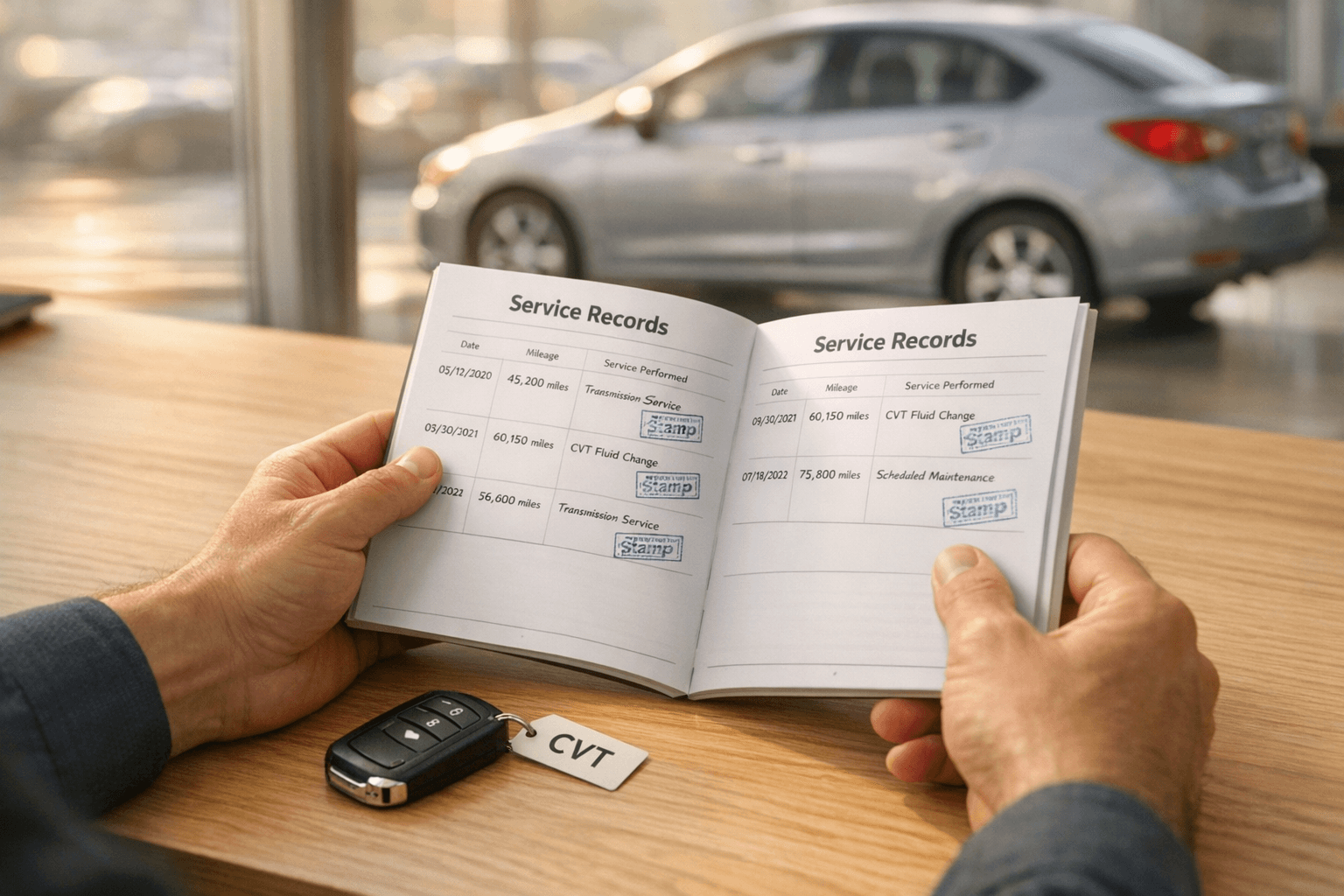
A car's service history can reveal a lot about its CVT health. Around 70% of CVT failures are linked to skipped fluid changes, so confirm that fluid replacements were done every 30,000 miles as recommended [11]. Owners who stick to these intervals report far fewer transmission issues [11].
Make sure the correct manufacturer-specific fluid was used. CVTs are very sensitive to fluid type, and using generic alternatives can cause severe damage [11][1]. Also, check if the work was done by dealer-trained technicians. General lube shops often make mistakes during drain-and-fill procedures.
"A lot of lube shops have bought a lot of transmission jobs over the years." – Dawn Mueller, Service Advisor [1]
Look for records of any software updates provided by the manufacturer to improve CVT performance [11].
If the car has a trailer hitch, confirm the manufacturer allows towing for that model and check for frequent fluid changes. Towing without an aftermarket fluid cooler can cause accelerated wear [12].
Even if the CVT is labeled as a "sealed" unit with "lifetime" fluid, ensure regular inspections for fluid discoloration or burnt smells every 15,000 miles. "Lifetime" often refers to the warranty period, not the actual lifespan of the transmission [11][1].
After reviewing records, take the car for a test drive to spot any hidden issues.
Test Drive Checklist
A test drive is your best opportunity to detect problems that might not be visible during a static inspection.
Engagement and Throttle Response: The CVT should engage in 1–2 seconds and deliver smooth power under both light and heavy throttle [12][1].
RPM Stability: At cruising speeds (50–60 mph), engine RPMs should remain steady, typically between 1,500 and 2,000. Fluctuating RPMs, also called "hunting", are a red flag [12][13].
Acceleration: Test how quickly the transmission adjusts ratios when accelerating from a lower speed (around 25 mph). It should respond within 1–2 seconds [12].
High-Load Conditions: Drive on steep inclines or merge onto a highway. Slipping or shuddering often shows up under these conditions [9].
Operating Temperature: Drive for at least 20 minutes to warm up the transmission. Some problems, like slipping, may only appear when the system is fully heated [13]. Be cautious if issues temporarily improve when warm, as this could mask underlying wear [9].
Fluid Check: If the car has a dipstick, inspect the CVT fluid. It should be pink or light brown with a slight pink tint. Avoid cars with dark brown or burnt-smelling fluid [12]. If you're unsure about a noise or sensation, test drive another car of the same make and model for comparison [13].
Timely Repairs: Addressing symptoms like RPM fluctuations early (within the first 500 miles) might only require a fluid service. Waiting too long - 2,000 miles or more - can lead to irreversible damage. CVTs with persistent slipping are unlikely to last beyond 500–1,000 miles before failing completely [9]. A pre-purchase inspection, costing around $100–$200, can help you catch transmission issues before committing to a purchase [12].
Used CVT Models with Good Reliability
Best Used CVT Cars Comparison: Honda Civic vs Subaru Crosstrek vs Toyota Corolla
Not all continuously variable transmissions (CVTs) are built the same. While earlier designs - like Nissan's models from 2003 to 2017 - struggled with reliability, modern CVTs from brands like Honda, Toyota, and Subaru have proven they can last well over 200,000 to 300,000 miles with proper maintenance [14][16]. These three manufacturers stand out for their lower failure rates and strong long-term value, making them excellent choices for used car buyers.
Honda Civic CVT
The Honda Civic, starting with the 2016 model year, has earned a reputation for its reliable CVT. According to Imperial Valley Honda, the 10th-generation Civics are particularly dependable [16]. Between 2015 and 2023, Honda's CVTs demonstrated a low failure rate of just 8.7% [18].
The 2023–2024 Civic models introduced a redesigned CVT with improved variator geometry, reducing belt stress by 31% [18]. However, even older models, like the 2016 Civic, remain a solid choice. These models are priced around $15,905 on the used market [14] and deliver an impressive highway fuel efficiency of roughly 36 mpg (about 6.5 L/100 km) [3]. Honda advises changing the CVT fluid every 30,000 miles using genuine HCF-2 fluid. With a compliance rate of 92% for this maintenance, many Honda CVTs surpass 300,000 miles [16][18].
Next up is Subaru, offering another reliable CVT option.
Subaru Crosstrek AWD CVT
The Subaru Crosstrek (2013–present) pairs its Lineartronic CVT with standard all-wheel drive (AWD), making it a strong performer in various weather conditions. Among used models, the 2015–2017 and 2020–2022 versions are recommended, as they avoid the reliability concerns tied to first-year redesigns [15]. RepairPal even gives the Crosstrek a top-tier reliability rating [15].
Subaru's CVT includes paddle shifters, allowing drivers to manually control power delivery - an uncommon perk in this segment [3][16]. However, earlier models (2010–2015) experienced issues with overheating, prompting Subaru to extend factory warranties to address these concerns [19]. The Crosstrek's failure rate is 14.9% [18]. First-generation models (2013–2017) are typically priced between $10,000 and $20,000, while second-generation models (2018–2023) range from $20,000 to $34,000 [15].
Lastly, the Toyota Corolla offers some of the best reliability in the CVT market.
Toyota Corolla CVT
The Toyota Corolla (2014–present) uses the CVT-i system, which helps eliminate the typical "rubber band" effect often associated with CVTs [3]. Starting with the 2019 model year, Toyota introduced the Direct Shift-CVT. This system uses a physical first gear for smoother acceleration before transitioning to a belt system for better highway efficiency [17].
Toyota CVTs have the lowest failure rate among major manufacturers, sitting at just 5.1% for models from 2018 to 2023 [18]. The 2014 Corolla earned a J.D. Power reliability score of 84/100 and is available for an average used price of $12,549 [14].
"The Toyota Corolla's CVT transmission is one of the most reliable CVTs on the market today" [17]
With regular maintenance, including fluid changes every 50,000 to 60,000 miles, the Corolla's CVT can last between 125,000 and 185,000 miles [17].
Model | Recommended Used Years | Average Used Price | Failure Rate | Advantage |
|---|---|---|---|---|
Honda Civic | 2016–Present | $15,905 (2016) [14] | 8.7% [18] | 31% less belt stress (2023+) and 300k+ mile potential [16][18] |
Subaru Crosstrek | 2015–2017, 2020–2022 | $10,000–$20,000 (1st Gen) [15] | 14.9% [18] | |
Toyota Corolla | 2014–Present | $12,549 (2014) [14] | 5.1% [18] |
How to Maintain Your CVT
Taking care of your CVT can make a huge difference in its lifespan. With proper maintenance, it can last over 200,000 miles. Neglect it, though, and you might face failure as early as 60,000 miles [21][23]. The key? Stick to these essential maintenance steps.
CVT Fluid Changes
CVT fluid isn't your standard transmission fluid - it’s specially formulated with friction modifiers to keep the belt gripping the pulleys while ensuring smooth lubrication. Using regular ATF? That’s a fast track to damaging your CVT [21].
While manufacturers suggest fluid changes every 60,000 to 100,000 miles for "normal" conditions, most experts recommend changing it every 30,000 miles if you drive under "severe" conditions [21][23]. And let's be honest - most of us do. Stop-and-go traffic, towing, extreme temperatures, or hilly roads all qualify. In fact, 85% of mechanics suggest sticking to the 30,000-mile interval no matter what the manual says [24].
"The difference between routine fluid service at 30,000 miles and waiting until 60,000 miles often means the difference between continued reliable service and a costly transmission replacement." - Rohnert Park Transmission [23]
Here’s a crucial point: always use the fluid your car manufacturer specifies. For example:
Nissan: NS-2 or NS-3
Honda: HCF-2
Toyota: CVT Fluid TC or FE
Subaru: High Torque CVTF
Mixing or substituting fluids can lead to failure. Statistics back this up - 30% of CVTs that weren’t serviced on time failed before hitting 100,000 miles [24], and 70% of CVT failures are linked to skipped fluid changes [11].
Don’t forget to check for leaks monthly. Look for reddish, pink, or amber fluid under your car, and use the dipstick (if your car has one) to smell the fluid. A burnt odor? That’s a red flag for immediate service [21]. The fluid should be clear or light amber - dark or murky fluid means it’s overdue for replacement.
Keeping your fluid in good shape goes hand in hand with maintaining the cooling system to avoid overheating.
Cooling System Maintenance
CVTs work under extreme pressure - over 1,000 PSI - and generate a ton of heat. Heat is the number one cause of CVT failure, which is why maintaining the cooling system is so critical [23].
Make it a habit to inspect cooler lines for leaks or blockages annually. Also, ensure your radiator, fan, and thermostat are functioning properly [25][20]. During oil changes, ask your mechanic to check that coolant is flowing through the transmission’s warmer/cooler system.
If you tow or drive in hilly terrain, consider installing an auxiliary transmission cooler. These aftermarket coolers can lower CVT operating temperatures by 20-40°F [23], offering extra protection against heat damage.
"Install an aftermarket cooler if you tow anything, even occasionally." - Fernando Gomez, Master Technician, Rohnert Park Transmission [21]
Your driving habits also play a role. In cold weather, let your transmission warm up for 5-10 minutes before accelerating aggressively. Avoid flooring the gas pedal, as sudden pulley ratio changes create heat spikes [26]. On long road trips, take breaks to let the transmission cool down [20].
CVT Maintenance Schedule Table
Service Type | Manufacturer "Normal" Interval | Recommended "Severe" Interval | Why It Matters |
|---|---|---|---|
Fluid Inspection | Every 15,000 miles | Every 5,000-10,000 miles | Checks for discoloration or burnt smell. |
Fluid Change | 60,000-100,000 miles | 30,000-40,000 miles | Prevents belt slippage and pulley scoring. |
Filter Replacement | Often not specified | Every 30,000-60,000 miles | Removes metal debris from belt wear. |
Cooling System Check | Every 30,000 miles | Every 15,000 miles | Prevents overheating, the #1 CVT killer. |
A typical CVT fluid and filter service runs between $100 and $300 [22], while replacing the entire transmission costs $3,000 to $7,000 [22]. Over the vehicle's lifetime, regular maintenance will set you back about $1,500 to $2,000 - a fraction of the cost of a single replacement [24]. Plus, sticking to a strict maintenance schedule can cut the risk of major transmission failure by 50% [11].
Conclusion
Buying a used car with a CVT can be a smart decision when you do your homework. Start by researching reliability. Brands like Honda (e.g., Civic 2016+, CR-V, Accord) and Toyota (Corolla) have proven to have dependable CVT systems. On the other hand, approach Nissan models from 2010–2018 and Subaru vehicles made before 2017 with caution. Be skeptical of claims like "lifetime fluid" - these often only apply during the warranty period. In reality, CVT fluid generally needs replacing every 35,000 to 60,000 miles [2]. Knowing this can help you make an informed purchase.
Getting a professional pre-purchase inspection is a must. Spending $100 to $200 on a trained mechanic can help you catch issues like belt wear, pulley damage, or sensor problems that might not be obvious [12].
"The $100 to $200 you'll spend [on an inspection] can save you tons of money in repairs on a poorly maintained vehicle" [12]
Service history matters. Look for cars with documented maintenance done by dealer-trained technicians who used the right CVT-specific fluids.
"A smooth-running CVT that you can prove has been serviced by its dealership on-time, every time, is your best choice for maximum peace of mind" [1]
Avoid vehicles that have been serviced at inexperienced lube shops, as they might use the wrong fluids or skip important steps, potentially leading to transmission failure. A solid service history ties everything together, ensuring the car's long-term reliability.
Consider buying from a trusted dealership. For example, Hello Motors (https://hellomotors.ca) specializes in pre-owned vehicles and verifies service records, confirms software updates, and ensures proper CVT care. They also offer flexible financing and home delivery, making the process convenient and reliable.
Once you've purchased the car, stick to the manufacturer's maintenance schedule. Regular fluid changes, cooling system checks, and moderate driving habits will keep your CVT running smoothly. With thorough research, a proper inspection, and ongoing care, a used CVT vehicle can be a reliable and fuel-efficient choice.