
Step-by-step guide to transferring vehicle ownership in Ontario: required documents (UVIP, bill of sale, SSC), fees, 6‑day registration deadline and tax rules.
Published Date:
Jan 17, 2026
Last Updated:
Jan 17, 2026
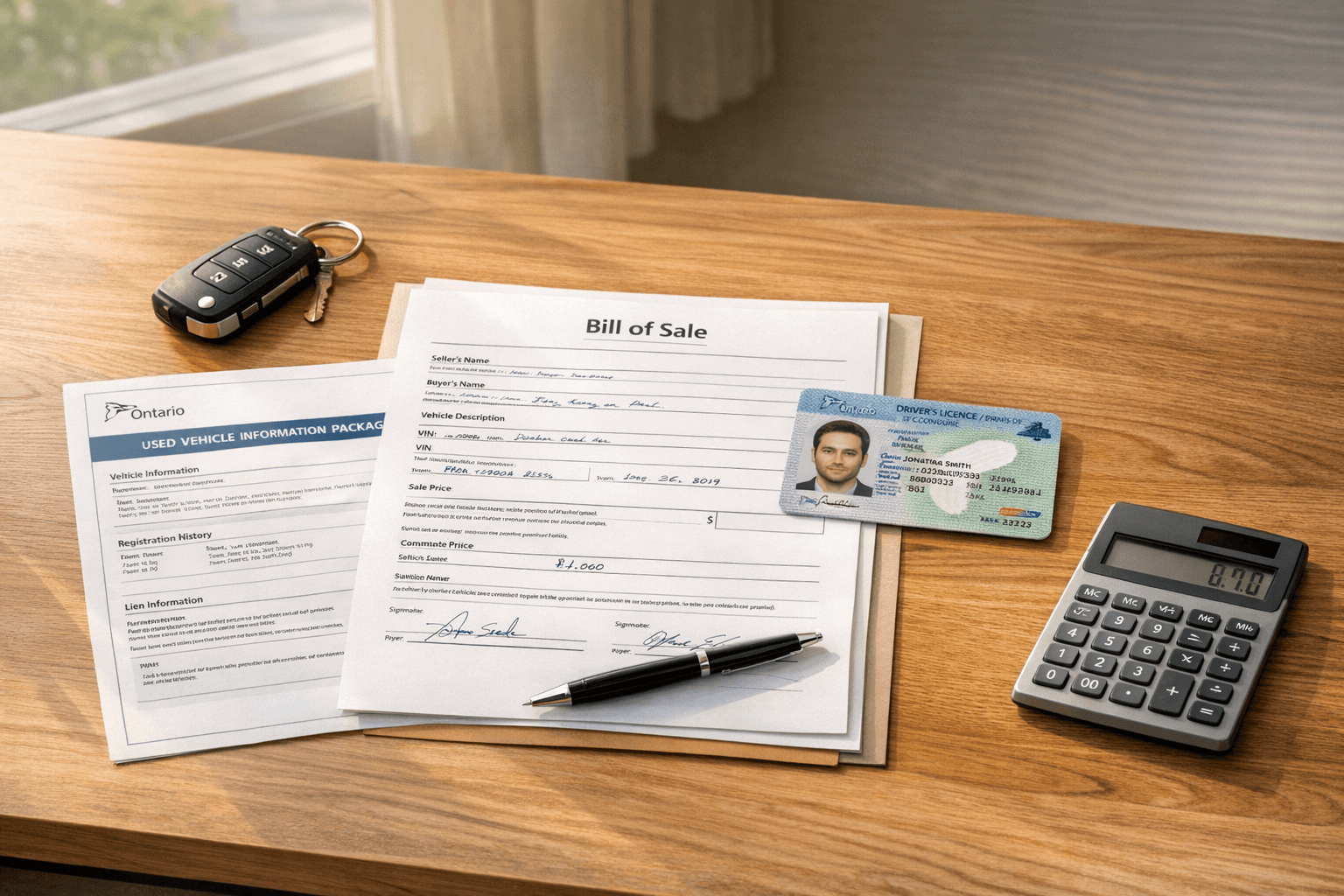
How To Transfer Vehicle Ownership In Ontario
Transferring vehicle ownership in Ontario is a straightforward process, but it requires attention to detail. Both the buyer and seller need to complete specific steps and provide the right documents to ensure the transfer is legally recognized. Here's what you need to know:
For Sellers: Provide the Used Vehicle Information Package (UVIP), the green ownership permit (with the transfer section completed), a Bill of Sale, and a valid Safety Standards Certificate (SSC). Remove your license plates and inform ServiceOntario of the sale.
For Buyers: Bring proof of identity, auto insurance, the completed UVIP, the signed Bill of Sale, and the SSC. Register the vehicle at ServiceOntario within 6 days of purchase. Be prepared to pay a $32 registration fee and 13% Retail Sales Tax.
Special cases, such as family transfers or estate vehicles, may require additional documents like a sworn statement or a death certificate. Always verify the VIN and ensure all paperwork is accurate before completing the transaction.
Skipping any step could delay the process or leave the seller legally liable for the vehicle. Follow these guidelines to transfer ownership smoothly and avoid complications.
How to Sign Over a Car Title to Someone in Ontario
Required Documents for Vehicle Ownership Transfer
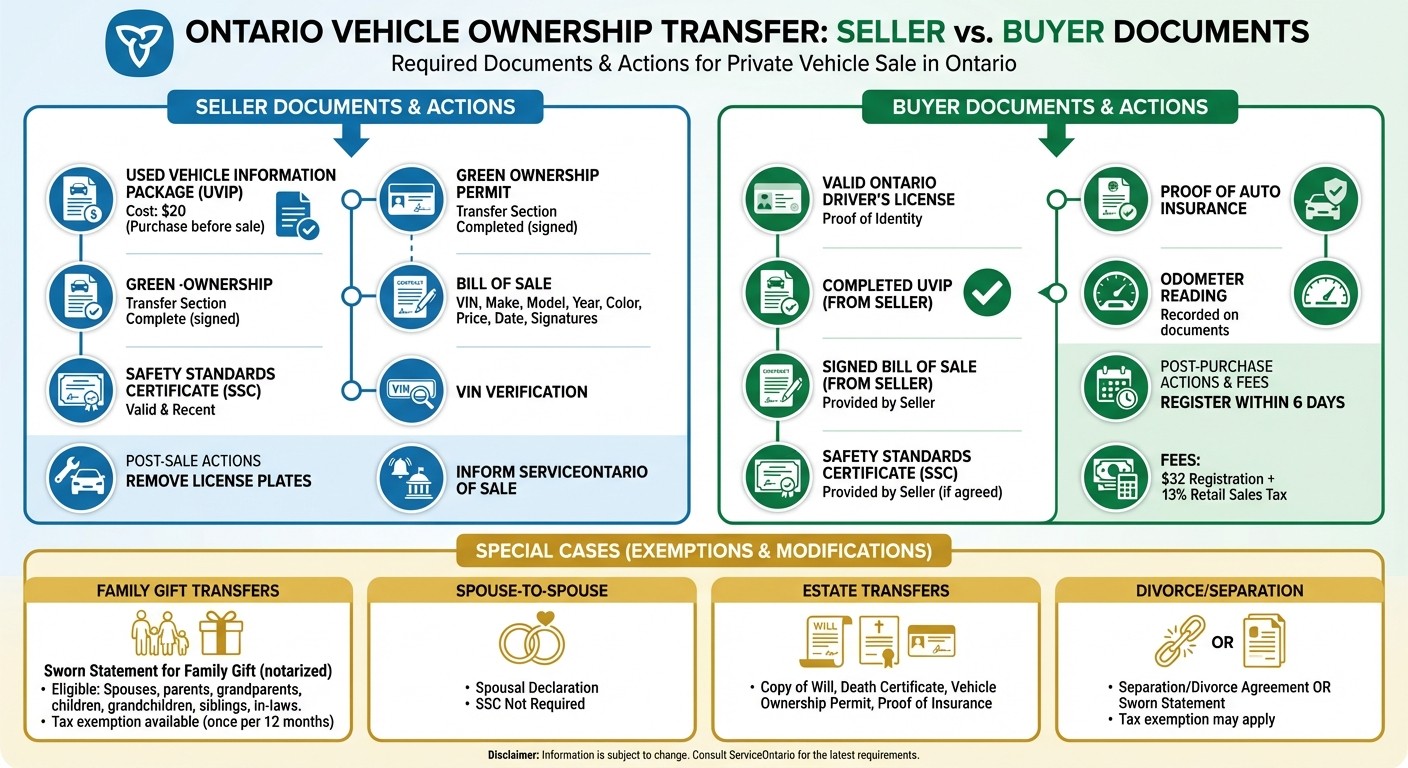
Required Documents for Vehicle Ownership Transfer in Ontario: Seller vs Buyer Checklist
Having the right paperwork is crucial for a smooth and legally compliant vehicle ownership transfer in Ontario. Both buyers and sellers need to prepare specific documents, and missing even one can delay or block the process.
What Sellers Need to Provide
Sellers are responsible for handing over several key documents to the buyer:
Used Vehicle Information Package (UVIP): This $20 document outlines the vehicle's registration history, lien status, and average wholesale value [4][8].
Green Ownership Permit: The seller must complete the "Application for Transfer" section on the vehicle portion of the green ownership permit and remove their license plates [4][5].
Bill of Sale: This must include essential details like the VIN, make, model, year, color, purchase price, sale date, and the names, addresses, and signatures of both parties [4].
Safety Standards Certificate (SSC): A valid SSC from a licensed mechanic confirms the vehicle meets minimum safety requirements [4].
VIN Verification: Ensure the VIN on the vehicle matches the one on the ownership permit [4].
With these documents in hand, the buyer can proceed with their part of the transfer.
What Buyers Need to Provide
Buyers also need to prepare several documents to complete the transfer:
Proof of Identity: A valid Ontario Driver's License or another acceptable ID showing their legal name, date of birth, and signature.
Proof of Insurance: A valid Ontario auto insurance policy is required to register the vehicle [5].
Documents from the Seller: These include the completed ownership permit, UVIP, and signed Bill of Sale [4].
Safety Standards Certificate (SSC): Required unless exempt under specific circumstances [4].
Odometer Reading: The current reading must be recorded at the time of transfer.
Registration Deadline: Buyers must register the vehicle with ServiceOntario within six days of purchase [9].
Certain situations, like family gifts or estate transfers, require additional paperwork.
Documents for Special Transfer Situations
Some transfers involve unique circumstances, such as family gifts, estate transfers, or separation agreements. Here’s what’s required:
Family Gift Transfers: Both parties must complete a "Sworn Statement for a Family Gift of a Used Motor Vehicle" in front of a lawyer or notary public to qualify for the 13% Retail Sales Tax exemption. Eligible family members include spouses (common-law included), parents, grandparents, children, grandchildren, siblings, and in-laws [2][10][1].
Spouse-to-Spouse Transfers: These do not require an SSC, but a "Spousal Declaration" form must be filled out instead [2][6].
Estate Transfers: Executors need to provide a copy of the Will, a death certificate, the vehicle ownership permit, and proof of insurance [6].
Divorce or Separation Transfers: A separation agreement, divorce agreement, or a "Sworn Statement for the Transfer of a Used Motor Vehicle" is needed to qualify for tax exemption [2].
Keep in mind, only one tax-exempt transfer of the same vehicle between family members is allowed within a 12-month period. Additionally, license plates can only be transferred between spouses, parents, and children with a "Plate Transfer Declaration" [2][10][6].
How Sellers Transfer Vehicle Ownership
Under the Highway Traffic Act, sellers need to follow specific steps to transfer vehicle ownership properly and shield themselves from future liability.
Providing the Used Vehicle Information Package (UVIP)
If you're selling a car, van, light truck (under 4,850 lbs), motorcycle, or motor home in Ontario, the Used Vehicle Information Package (UVIP) is a must-have document for private sales [8]. It costs $20 and contains key details like the vehicle's Ontario registration history, past owners and their cities, odometer readings, and any registered liens or debts. It also includes the average wholesale value, which is used to calculate the 13% Retail Sales Tax.
To get a UVIP, you’ll need the Vehicle Identification Number (VIN) or license plate number, along with your Ontario driver’s license or registrant identification number (RIN). Order it at least 15 days before listing your vehicle, as processing can take up to 5 business days, and mailing adds up to 10 more. Keep the original UVIP intact, including the tear-off stub, as this will be handed to the buyer.
Note that UVIPs aren’t required for transfers to family members, registered dealers, or licensed charities. Once the UVIP is ready, you can complete the sale by preparing the Bill of Sale and Ownership Permit.
Filling Out the Bill of Sale and Ownership Permit
Using the information from your UVIP, fill out the Bill of Sale and Ownership Permit. The Bill of Sale must include details such as the VIN, make, model, year, power source, body type, color, purchase price, sale date, and the names, addresses, and signatures of both parties. You can either use the section provided at the bottom of the UVIP or draft a handwritten document containing all these details.
The green ownership permit has two parts: the vehicle portion and the plate portion. On the back of the vehicle portion, complete and sign the "Application for Transfer" section, then hand it over to the buyer along with the UVIP. Keep the plate portion for your records, as it’s needed to transfer your license plates to another vehicle or to request a refund for any unused validation months.
Finalizing the Sale and Informing Authorities
Once the paperwork is done, remove your license plates from the vehicle. In Ontario, plates stay with the owner, not the vehicle.
After the sale, visit a ServiceOntario location with a document listing the VIN, sale date, and buyer’s name to officially mark the vehicle as sold. This step is crucial - it protects you from liability if the buyer delays registering the vehicle or if anything happens before the transfer is completed.
How Buyers Complete the Ownership Transfer
Checking and Completing Your Documents
Before heading to ServiceOntario, double-check that the VIN (Vehicle Identification Number) on the vehicle permit matches the one on the dashboard. Also, review the UVIP (Used Vehicle Information Package) to ensure there are no outstanding liens that could lead to repossession issues[4]. You'll need to gather a few key documents: your Ontario driver’s license, proof of auto insurance (your pink liability card), the Bill of Sale (often found at the bottom of the UVIP), and a Safety Standards Certificate if you plan to drive the car right away. For vehicles 20 years or older, an appraisal document is required to calculate the Retail Sales Tax (RST)[4].
Registering Your Vehicle at ServiceOntario
Once your documents are in order, head to a ServiceOntario center to register your vehicle. Keep in mind, you must complete the registration process within 6 days of the purchase date[7]. Bring everything with you, including your proof of insurance, the UVIP, the Bill of Sale, and the seller's vehicle permit. If you don’t have a Safety Standards Certificate yet, you can request a 10-day temporary sticker, allowing you to drive the car for inspection purposes[7].
At the ServiceOntario center, you’ll need to pay a $32 fee for the vehicle permit and 13% Retail Sales Tax. The tax is calculated based on the higher amount between the purchase price and the vehicle’s wholesale value[7]. Payment can be made using various methods.
Getting Your License Plates and Ownership Permit
The final step is securing your license plates and ownership permit. If you’re buying new plates, it will cost $59, which includes the permit fee[7]. If you are still looking for your next vehicle, you can browse used car inventory available for delivery across Ontario. If you already have plates from another vehicle, bring the "plate portion" of your current permit so the plates can be transferred to your new car. In Ontario, license plates are tied to the owner, not the vehicle.
Once your registration is complete, you’ll receive your vehicle permit and standard license plates on the spot, officially finalizing the ownership transfer.
Transfer Fees and Costs in Ontario
Standard Transfer and Licensing Fees
If you're transferring vehicle ownership in Ontario, the basic vehicle permit, which serves as the ownership document, costs $32 at ServiceOntario. Need new license plates? That bumps the total to $59. Since March 13, 2022, license plate renewal fees for passenger vehicles, motorcycles, and light commercial vehicles have been eliminated - renewals are now automatic and free, as long as you don’t have any outstanding fines or tolls. If you need a replacement sticker, it’ll cost you $7. Just a heads-up: any unpaid fines, fees, or tolls tied to your name must be settled before you can complete the registration process.
Retail Sales Tax and Exemptions
On top of the standard fees, buyers are responsible for paying 13% Retail Sales Tax (RST). This tax is calculated based on the higher value between the purchase price and the vehicle's wholesale value listed in the Canadian Red Book. Got a vehicle that's 20 years or older? You'll need an appraisal to determine its taxable value. However, there are some exemptions. If the vehicle is a gift from a family member, you may qualify for an exemption by completing the "Sworn Statement for a Family Gift of a Used Motor Vehicle" form. Keep in mind, this exemption is limited to one vehicle per 12 months. Transfers between spouses due to a Family Law Act settlement, like in cases of divorce or separation, may also qualify for an exemption.
Safety Certificate and Inspection Costs
Another expense to consider is the Safety Standards Certificate, which is mandatory for most ownership transfers. This certificate, valid for 36 calendar days, confirms the vehicle met Ontario's minimum safety standards on the inspection date. The exception? Transfers to a spouse don’t require this certificate. The cost of the inspection and certificate varies because pricing isn’t regulated by the government - each licensed DriveON inspection station sets its own rates.
"The cost of a safety standard inspection and the certificate is different at each Motor Vehicle Inspection Station. This isn't regulated by the government." - Ontario.ca
If you don’t have the certificate yet, you can request a 10-day temporary sticker for $23.50. Note that trailers, mopeds, off-road vehicles, and motorized snow vehicles are exempt from needing safety certificates.
Family and Estate Vehicle Transfers
Transferring Vehicles to Family Members
When transferring a vehicle to a family member, there are specific steps to follow, and in some cases, you can avoid paying the 13% RST. Eligible family members include your spouse (including common-law), parents, step-parents, grandparents, children, grandchildren, in-laws, and siblings (including half and adopted siblings). Keep in mind, only one tax-free transfer is allowed per vehicle each year.
To proceed, you’ll need to complete a "Sworn Statement for a Family Gift of a Used Motor Vehicle" and have it signed in front of a lawyer or notary public. After that, head to ServiceOntario to finalize the transfer. The recipient must have valid Ontario auto insurance in their name and register the vehicle within 6 days. For spouse-to-spouse transfers, a Safety Standards Certificate isn’t required; instead, you’ll need a spousal declaration.
If you’re transferring license plates between spouses, parents, or children, you’ll need to fill out a Plate Transfer Declaration. Also, make sure any car loans are fully paid off, as liens can block the transfer.
Document Required | Family Gift (General) | Spouse-to-Spouse | Estate Transfer |
|---|---|---|---|
Sworn Statement for Family Gift | Yes | Yes | No |
Safety Standards Certificate | Yes | No (Spousal Declaration) | Yes |
Proof of Insurance | Yes | Yes | Yes |
Vehicle Ownership Permit | Yes | Yes | Yes |
Death Certificate / Will | No | No | Yes |
Plate Transfer Declaration | Optional (Parents/Children) | Optional | No |
For estate-related transfers, additional documentation is required, and the process varies depending on the circumstances.
Transferring Vehicles Through an Estate
When a vehicle is transferred through an estate after someone passes away, the executor of the estate is responsible for managing the process. The executor must visit a ServiceOntario center in person and bring the following items:
A copy of the will
The vehicle’s ownership permit (the green document)
Their personal ID
Proof of valid Ontario insurance
The death certificate
If the vehicle was jointly owned by married spouses, the surviving spouse can transfer the ownership into their name by simply providing the death certificate.
For situations where there is no will (intestate cases), the executor or representative must prove their right to the vehicle. This often involves presenting a lawyer’s letter of opinion to the Ministry of Transportation. If the executor is transferring the vehicle to another eligible family member, the same family gift rules and tax exemptions apply. Just remember, a Safety Standards Certificate is required unless the vehicle is being transferred to a spouse.
Summary
Transferring vehicle ownership in Ontario involves a series of specific steps for both the seller and the buyer. The seller must provide a Used Vehicle Information Package (UVIP), a signed Bill of Sale, and the vehicle portion of the ownership permit with the transfer application filled out. On the buyer's side, they need valid Ontario auto insurance and, if required, a Safety Standards Certificate. The buyer must also register the vehicle at ServiceOntario within 6 days of purchase [4]. Missing any required documentation can delay or stop the transfer process [1].
Until the buyer completes the registration, the seller remains legally responsible for the vehicle. This means that if the vehicle is used in a crime, the registered owner could face legal consequences [4][6]. Sellers also risk financial exposure, as insurance claims are only valid for the registered owner [6]. Double-checking all documents and details before finalizing the transfer is critical.
It's important to verify that the dashboard VIN matches the information on the ownership permit. Sellers should also remove their license plates immediately, as liability remains until the buyer completes registration [4][3]. The transfer fee is $32, plus a 13% Retail Sales Tax based on the higher value between the purchase price and the Canadian Red Book wholesale value [1][4].
For special cases, such as family or estate transfers, additional rules apply. Family transfers can avoid the 13% tax by submitting a completed Sworn Statement for a Family Gift. Estate transfers require documents like a death certificate and the will. Meeting the 6-day registration deadline is essential to ensure compliance and a smooth transition of ownership [4][6].