
Accident repairs often lower a car's resale value by 10–30%. Learn how severity, repair quality, OEM parts and documentation affect value and how to limit losses.
Published Date:
6 mars 2026
Last Updated:
6 mars 2026
Do Accident Repairs Hurt Resale Value?
Yes, accident repairs can reduce your car's resale value, even if the repairs are flawless. Here's why:
Diminished Value: After an accident, cars typically lose 10%–30% of their pre-accident value, even with professional repairs. For a $30,000 car, this could mean a loss of $3,000–$9,000.
Buyer Concerns: Buyers worry about hidden damage, safety risks, or poor repair quality, which lowers their willingness to pay.
Accident Records: Services like Carfax create a permanent record of the accident, impacting trade-in offers and private sales.
Repair Quality Matters: Using OEM parts and certified repair shops can help retain more value, but aftermarket parts or poor repairs can worsen depreciation.
To reduce resale value loss:
Use certified repair shops and insist on OEM parts.
Keep detailed repair records, including invoices, photos, and warranties.
Be transparent with buyers about the accident and repairs.
While you can't erase an accident from your car's history, proper repairs and documentation can help minimize the financial impact.
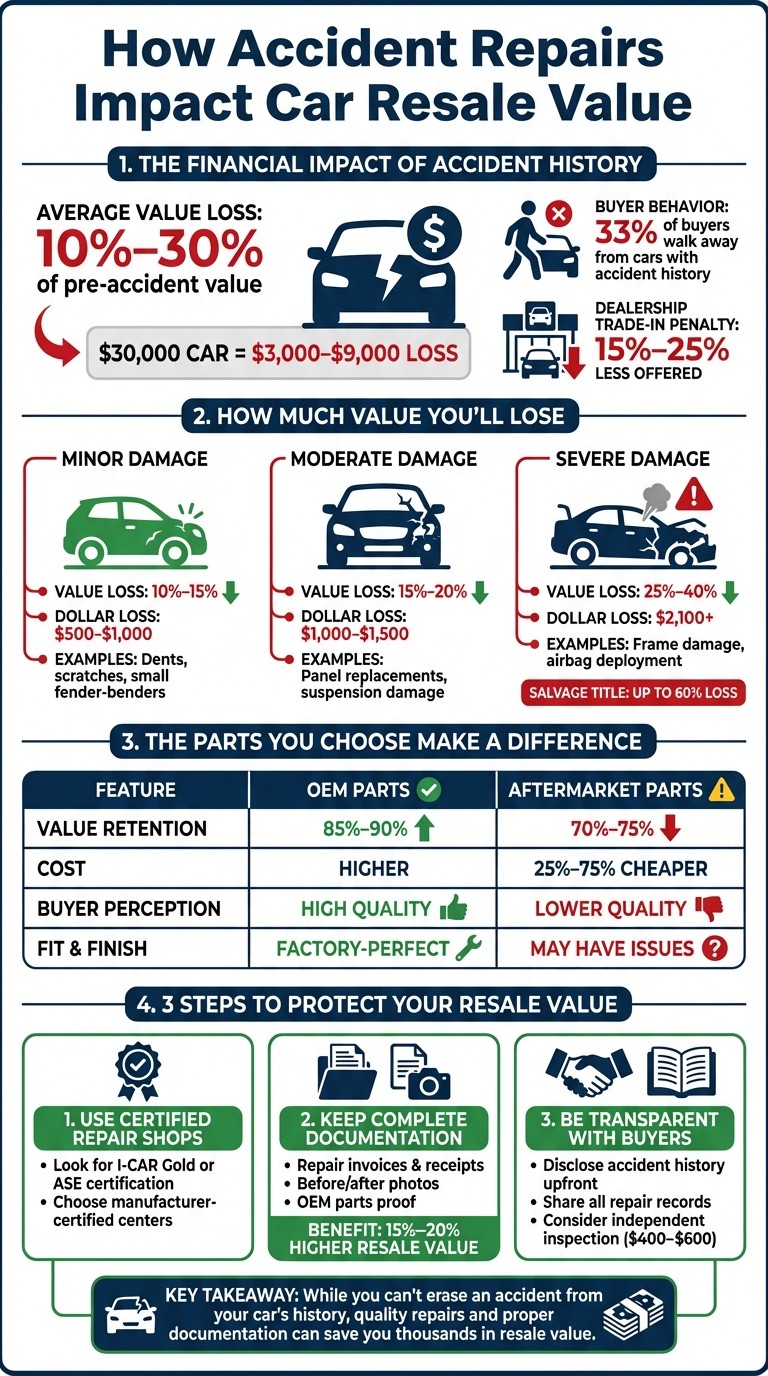
How Accident Repairs Impact Car Resale Value: Statistics and Loss Percentages
What is diminished value of a vehicle after a crash?
How Accident History Affects Resale Value
Accident repairs hurt a car's resale value, no matter how well the repairs are done. Why? Because both buyers and dealerships tend to penalize any vehicle with an accident record. Reports from services like Carfax or AutoCheck create a permanent trail of the incident, which lowers the price people are willing to pay.
Here’s the reality: about 33% of used car buyers will walk away if they find out a car has been in an accident. Dealerships, on the other hand, might offer 15% to 25% less for trade-ins with a collision history [10]. These lower offers often come immediately after reviewing the vehicle’s history report.
"No reasonable and prudent person is willing to pay the same price for a vehicle with a history of damage as they would for one never having been damaged." – Wikipedia [4]
This hesitation comes from concerns about hidden structural damage, potential mechanical problems, and safety risks that might not show up right away. Even if the car functions perfectly, its accident history raises red flags for buyers. These concerns translate into lower offers, whether you’re selling privately or trading it in. This automatic market penalty is known as diminished value.
What Is Diminished Value?
Diminished value refers to the reduction in a car’s market value after it’s been in an accident. There are three main types:
Inherent diminished value: The automatic loss in value simply because the car has an accident on its record, regardless of how well it was repaired [1][8].
Repair-related diminished value: Additional loss caused by poor repairs, such as mismatched paint, uneven panel gaps, or the use of aftermarket parts instead of Original Equipment Manufacturer (OEM) parts. Using OEM parts can help retain 85% to 90% of the car’s pre-accident value, while aftermarket parts often drop that retention to 70% to 75% [10].
Immediate diminished value: The difference between the car’s pre-accident value and its value as a damaged vehicle before repairs. This is often used in insurance or legal evaluations [1][7].
How Much Value Gets Lost?
The impact of accident history on resale value varies, but most cars lose 10% to 30% of their pre-accident value [10]. For example, a car worth $30,000 could see its value drop by $3,000 to $9,000 after an accident.
Minor cosmetic damage: Issues like dents, scratches, or small fender-benders typically reduce the car’s value by 10% to 15%, which could mean a loss of $500 to $1,000 depending on the car’s original price [10][1]. For instance, a 2024 Hyundai Tucson SEL FWD with just 2,780 miles underwent minor cosmetic repairs estimated between $650 and $715 using the 17c formula. However, one insurer settled for only $400 [1][6].
Moderate damage: Repairs involving panel replacements or minor structural fixes can result in losses of about $1,000 to $1,500 for standard vehicles [1][6].
Severe damage: Major structural repairs can lead to losses exceeding $2,100, especially for newer or high-end cars [1][10]. Cars with low mileage or newer models tend to lose a larger percentage of their value because buyers expect them to have a flawless history.
Luxury and performance vehicles take the biggest hit, with diminished values ranging from 15% to 30%. By comparison, mainstream cars that are 0–3 years old typically lose 10% to 20% of their value after an accident [8].
How Accident Severity Changes Resale Value
The severity of an accident plays a major role in determining how much resale value a vehicle loses. Damage to the structure, frame issues, or airbag deployment can lead to steep price drops. Even minor accidents leave a permanent record that can scare off buyers - up to 55% of used car shoppers might avoid vehicles with any accident history [11][12].
To estimate this loss, insurance companies often rely on the 17c Formula. This method uses specific multipliers based on the extent of the damage [1][6]. Here's a closer look at how different levels of accident severity affect resale value.
Minor Accidents
Minor accidents, like scratches, small dents, or light collisions, have a relatively low impact on resale value. These types of incidents don’t harm the car’s structure and usually result in a value reduction of 5% to 10% [8][9]. Even with flawless repairs, trade-in offers might drop by 3%–10% [8]. For instance, a $25,000 car could lose between $750 and $2,500. Insurance companies often classify this as "minor damage to structure and panels", applying standard multipliers to calculate the loss [6].
Moderate Accidents
When damage goes beyond surface-level issues, moderate accidents come into play. These can involve panel replacements, suspension damage, or drivetrain repairs. Such incidents typically lower a vehicle’s resale value by 15% to 20% [8][13]. Buyers often worry about hidden problems that might emerge later. For example, a $30,000 car could see its value drop by $4,500 to $6,000. In these cases, the 17c Formula also incorporates specific multipliers to reflect the extent of the damage [6].
Severe Accidents
Severe accidents - those involving major structural or frame damage and airbag deployment - have a much larger impact on resale value. Depending on the extent of the damage, the loss can range from 10% to 30% [12]. For vehicles with significant structural issues or multiple panel replacements, the resale value might drop by as much as 30% to 50%. Airbag deployment or frame damage alone can result in a 25%–40% reduction in value [10][11][13].
In extreme situations, when a vehicle is declared a total loss and receives a salvage title, the devaluation can reach up to 60% [11]. At this point, private buyers are often unwilling to purchase the car, leaving sellers with few options outside of salvage yards or specialty dealerships.
These examples highlight how the severity of an accident directly affects a vehicle's market value, with both buyers and sellers feeling the impact.
Why Buyers Avoid Vehicles with Accident History
The impact of accident history on a vehicle's resale value goes beyond numbers - it's also about perception. Buyers often shy away from vehicles with accident records for reasons that extend far beyond surface-level damage. In fact, up to 33% of potential used car buyers will back out of a deal entirely if they uncover any accident history [10]. This reluctance is rooted in concerns about safety, reliability, and potential financial pitfalls.
At the heart of this hesitancy are fears about structural integrity and repair quality. Even when repairs make a car look as good as new, many buyers worry about hidden weaknesses. These concerns are not unfounded - structural damage from accidents can compromise a vehicle's safety and handling in future collisions. According to the Insurance Institute for Highway Safety (IIHS), cars with accident records are at greater risk of having safety systems fail [14]. As Joses Peter, Content Writer at Instant VIN Reports, puts it:
"An accident can raise questions about the car's safety, structural integrity, and potential for future mechanical issues" [9].
Beyond structural worries, buyers are also uneasy about potential hidden mechanical damage. Electrical systems, sensors, or drivetrain components could have been affected in ways that might not show up immediately but could cause problems months down the line [9][15]. Add to that lingering doubts about the quality of repairs, and it's easy to see why many buyers would rather avoid the risk.
Another major deterrent is the long-term challenge of reselling the vehicle. Buyers know that an accident history can lead to tough price negotiations and scare off future buyers. As Schaar & Silva explain:
"The stigma that buyers attach to accident reports often outweighs the actual damage severity" [10].
Lastly, insurance and financing hurdles can also play a role. Vehicles with accident histories may come with higher insurance premiums, and some lenders might hesitate to provide financing for them [7][15]. Taken together - safety concerns, hidden damage fears, doubts about repairs, resale difficulties, and financial complications - these factors make vehicles with a clean history far more appealing to most buyers. This persistent skepticism contributes to the lower market value of accident-damaged cars over time.
How Repair Quality Changes Resale Value
The quality of repairs after an accident plays a major role in determining a vehicle's resale value. High-quality repairs can help preserve a car's worth, while poor workmanship can lead to significant losses. Buyers are quick to notice issues like mismatched paint, uneven gaps, or poorly fitted parts, and these flaws often lead to aggressive price negotiations [10][12]. On the other hand, professional repairs that meet factory standards can maintain much of the car's original value and reassure buyers, making them more likely to pay a fair price.
The type of parts used during repairs also has a big impact. OEM parts (Original Equipment Manufacturer) are made specifically for your car, ensuring a perfect fit and maintaining safety standards. In contrast, aftermarket parts, though often 25% to 75% cheaper [17], can signal to buyers that cost-cutting measures were taken, potentially lowering their confidence in the repair quality.
Choosing a certified repair shop is just as important as the parts used. Shops certified by your car's manufacturer or those with credentials like I-CAR Gold or ASE certification follow strict procedures and use specialized tools [10][12]. This level of professionalism not only improves repair quality but also builds buyer trust. As Indus Used Cars explains:
"Buyers are more likely to trust a car with documentation that shows it was repaired properly, and dealerships may offer a better trade-in value when they see that the car has been cared for post-accident" [16].
Why Repair Documentation Matters
Having detailed repair records is one of the best ways to address buyer concerns. These records show that repairs were done correctly and can even increase your car's resale value by 15% to 20% compared to similar vehicles without documentation [10].
Your repair documentation should include key items like the police report, insurance correspondence, itemized repair invoices, and before-and-after photos of the vehicle [10][15]. If OEM parts were used, ensure the receipts clearly state this. Written warranties for repair work and paint matching are also valuable, as they often transfer to the new owner, providing additional reassurance [10]. Schaar & Silva LLP emphasize the importance of records:
"Detailed maintenance records increase buyer confidence and can boost resale value by 15% to 20% compared to vehicles without complete repair documentation" [10].
To further strengthen your position, consider a post-repair inspection by an independent mechanic. This third-party verification can help uncover any hidden damage and provide a solid foundation for negotiations [15][12]. While such inspections typically cost $400–$600, they can lead to an additional $3,000 to $8,000 in insurance settlement value by accurately documenting the car's condition [10]. Keep digital backups of all records in cloud storage for easy access when dealing with buyers or dealerships [10].
OEM Parts vs. Aftermarket Parts
The choice between OEM and aftermarket parts can dramatically affect how buyers view the quality of repairs. OEM parts are made by the vehicle's original manufacturer, ensuring they match the car's original specifications. Aftermarket parts, produced by third-party companies, may differ in fit, finish, and durability.
Feature | OEM Parts | Aftermarket Parts |
|---|---|---|
Value Retention | Maintains 85%–90% of pre-accident value [10] | Maintains 70%–75% of pre-accident value [10] |
Fit & Finish | Factory-perfect | May have alignment issues |
Cost | Higher | 25–75% cheaper [17] |
Buyer Perception | Seen as higher quality and reliable [16] | Often viewed as lower quality [16] |
While aftermarket parts save money upfront, they often lead to repair-related diminished value, as they may not fully restore the car to its original condition [16][7]. This is especially true for luxury vehicles, where 75% of buyers expect a discount if the car has an accident history [17].
To avoid these pitfalls, inquire about adding an OEM parts endorsement to your insurance policy to ensure coverage for high-quality components [17]. Insist on using OEM parts for repairs and include proof of this in your documentation. This transparency helps build trust with buyers and supports a higher resale price, even if the vehicle has an accident history on record.
How to Reduce Resale Value Loss After an Accident
After an accident, the steps you take can greatly influence how much value your vehicle retains. While you can't remove the accident from the car's history, you can take practical steps to limit the financial hit. Smart decisions about repairs, documentation, and transparency with buyers can make all the difference.
Use Certified Repair Shops
One of the first things to do is choose a certified repair shop. Look for facilities with I-CAR Gold Class or ASE certification [3]. Even better, opt for a manufacturer-certified center. These shops specialize in your vehicle's make and model, ensuring repairs meet factory standards.
Certified repair shops use the right tools and techniques to restore your car's structural integrity, which is crucial for safety and resale value. They also rely on advanced color-matching technology to avoid mismatched paint - something that could hint at past damage to future buyers [16]. High-quality repairs not only maintain your car's appearance but also help reduce its diminished value.
Keep Complete Records
Professional repairs are essential, but thorough documentation can further reassure potential buyers. Keep a complete file that includes:
The police report
Detailed repair invoices
Receipts for parts (especially if you used OEM parts)
Before-and-after photos [10]
Storing digital copies in cloud storage makes sharing this information with buyers or dealerships much easier.
You might also consider a post-repair inspection by an independent mechanic. While these inspections usually cost $400 to $600, they can validate the quality of repairs. This step can even help you recover an additional $3,000 to $8,000 in an insurance settlement [10]. As SJL Auto LTD explains:
"A well-maintained repair record that shows professional work can reassure buyers that the car is safe and reliable" [15].
Be Honest with Buyers
Transparency is key when selling a car with an accident history. Being upfront about past damage is not only ethical but also a smart strategy. Buyers who discover accident history through third-party reports - rather than directly from you - are more likely to back out of the deal [10].
Provide repair documentation, inspection reports, and photos to build trust. Since many repair shops report work to services like Carfax automatically, trying to hide an accident is rarely effective [3]. As SJL Auto LTD points out:
"Transparency builds trust. If you show buyers repair receipts, inspection reports, and before-and-after photos, they may feel more confident about purchasing your car, even if it has been in an accident" [15].
While disclosing an accident may result in a slightly lower sale price compared to a vehicle with a clean history, it can lead to quicker sales and help you avoid potential legal issues.
Conclusion
Accidents can take a toll on your car's resale value - even with perfect repairs. On average, a vehicle with an accident history loses about 10%–25% of its market value, translating to a $3,000–$7,500 hit on a $30,000 car [2][15].
How much value you lose often depends on what you do after the accident. Opting for high-quality repairs and maintaining detailed documentation can help minimize further losses [5][7]. On the other hand, shoddy repairs or the use of aftermarket parts can worsen depreciation, making it crucial to prioritize skilled workmanship.
While you can't completely erase an accident from your car's history, you can reduce its financial impact. Buyers are more likely to feel confident about your car's safety and condition if you provide proof of quality repairs and proper maintenance records. This can make a big difference when it's time to sell.
To safeguard your car's value, stick to certified repair shops, keep thorough records, and be upfront with potential buyers.