
Measure tire tread with a gauge or coin; replace at 4/32 in for wet roads, 6/32 in for winter, and watch for uneven wear or damage.
Published Date:
17 janv. 2026
Last Updated:
17 janv. 2026
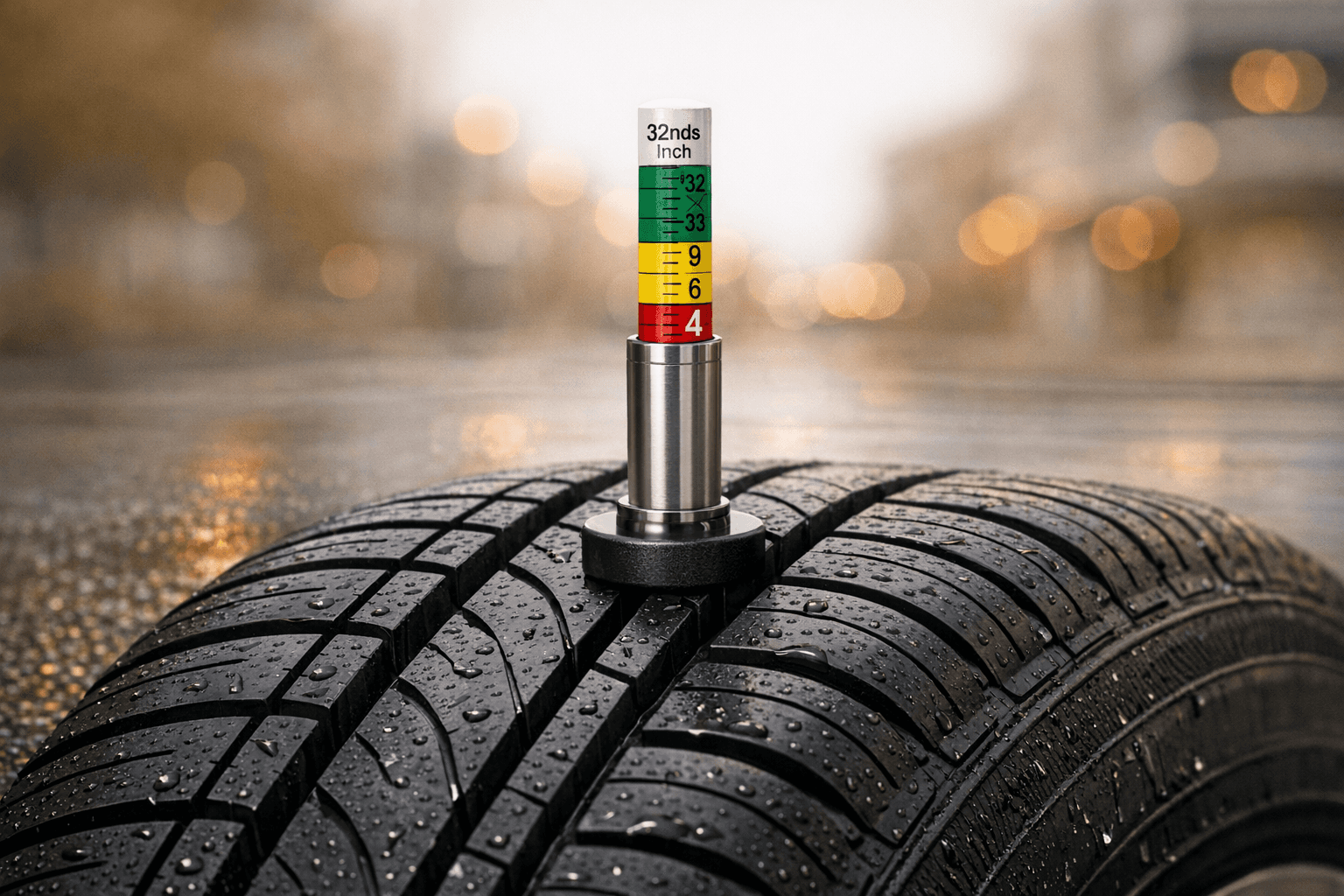
When to Replace Tires by Tread Depth
Tire tread depth directly impacts your safety on the road. Here's what you need to know:
Replace tires at 4/32 inches for reliable wet-weather performance. Waiting until the legal limit of 2/32 inches greatly increases stopping distances and the risk of accidents.
Use a tread depth gauge or coin test to measure tread depth. A quarter test can warn you earlier than a penny test.
Winter driving requires at least 6/32 inches for proper traction in snow and ice.
Uneven wear patterns may signal alignment or inflation issues, which should be addressed promptly.
Built-in tread wear indicators help identify when your tires reach the legal minimum.
Regularly check your tires to ensure safety and plan replacements before performance deteriorates.
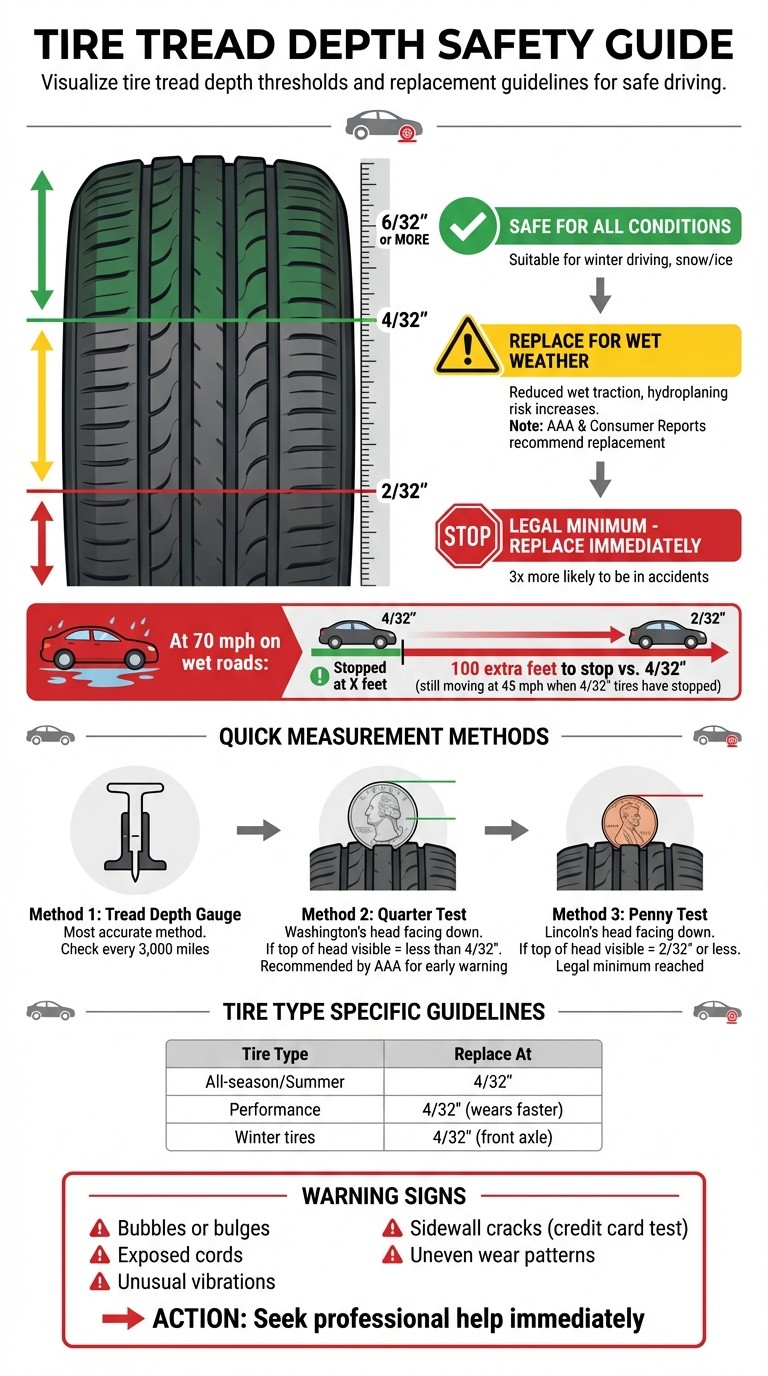
Tire Tread Depth Safety Guide: When to Replace Your Tires
Tread Depth Basics and Legal Requirements
How to Measure Tread Depth
Tread depth refers to the vertical distance between the surface of a tire and the bottom of its deepest grooves. In the U.S., this measurement is expressed in 32nds of an inch [5]. Brand-new passenger car tires typically start with a tread depth of 8/32" to 11/32", while light truck tires range from 11/32" to 19/32" [6][7]. As the tread wears down, a tire’s ability to grip the road and channel water decreases significantly. Shallow grooves mean less water evacuation, which can lead to longer stopping distances and a higher risk of hydroplaning [5]. Knowing how to measure tread depth is essential for comparing legal limits with recommended safety guidelines.
Legal Minimum vs. Safe Minimum Tread Depth
In most U.S. states, tires are considered legally worn out - or "bald" - when their tread depth reaches 2/32" [5][6]. However, legal requirements can vary. For instance, Texas mandates a minimum tread depth of 3/32" for vehicle inspections, while states like California and Idaho may allow as little as 1/32" [7]. That said, just meeting the legal minimum doesn’t ensure safe driving. Safety experts, including AAA and Consumer Reports, advise replacing tires once the tread depth falls to about 4/32". At this point, tires can still provide reliable grip and braking performance, especially in wet conditions [8][2]. By the time tread depth hits 2/32", much of the tire’s ability to handle adverse weather is already compromised.
Built-In Tread Wear Indicators
Many tires come with built-in tread wear indicator bars, which are small molded rubber strips located in the main grooves of the tread. These indicators are precisely set at 2/32" [9][3]. As the tread wears down, the bars become more visible. When the surface of the tread is level with these bars, it’s time to replace the tire [5][9].
"When the tread wear bar located in the tread groove is flush with the surface of the tread, the tire is worn to 2/32" (1.6mm) and should be replaced."
– Goodyear [9]
Most tires are designed with at least six of these wear bars, evenly spaced around the tire’s circumference [9]. You’ll find them in the major grooves, appearing as narrow, smooth strips that run across the tread pattern. When these bars become prominent, it’s a clear sign that the tire’s performance is no longer reliable [9][1]. This visual cue makes it easier to determine when a tire has reached the end of its useful life.
How To Know When You Need New Tires & Does A Penny Really Work To Measure Your Tire Tread Depth?
Measuring Tread Depth Yourself
Knowing how to measure your tire’s tread depth is crucial for keeping your vehicle safe and performing well on the road.
Using a Tread Depth Gauge
The most reliable way to measure tread depth is with a tread depth gauge. This handy tool has a T-shaped frame and a sliding needle that fits into the grooves of your tire. It provides readings in 32nds of an inch, giving you a clear picture of how much tread remains.
To use it, place the gauge’s flat base across two tread blocks and push the needle down until it touches the bottom of the groove. Then, remove the gauge and note the reading. Since tire wear isn’t always even, check multiple spots across the tire’s width - from the center to the edges - and around the entire circumference. It’s a good idea to measure tread depth every 3,000 miles or once it reaches 4/32 of an inch. Don’t have a gauge? No problem - coin tests can also help.
The Penny and Quarter Tests
If you don’t have a tread depth gauge, grab a penny or a quarter. These simple coin tests can give you a quick estimate of your tire’s condition.
For the penny test, insert a penny into a tread groove with Lincoln’s head facing down. If you can see the top of his head, your tread depth is 2/32 inch or less, which is the legal minimum in most states. At this point, it’s time to replace your tires immediately.
The quarter test offers an earlier warning. Place a quarter into the groove with Washington’s head facing down. If the tread doesn’t cover the top of his head, your tread depth is less than 4/32 of an inch. AAA recommends using the quarter test because it alerts you when traction may start to decrease in wet conditions - long before your tires become unsafe. Be sure to check several spots on each tire to account for uneven wear.
Checking for Uneven Wear
Measuring tread depth in different areas of the tire can reveal useful insights about its overall condition. Focus on three key zones: the center, the inner edge, and the outer edge. Uneven wear patterns can indicate mechanical issues. For instance:
Excessive wear in the center often means your tires are over-inflated.
Wear along both edges suggests under-inflation.
If just one edge is worn down, it could point to alignment or suspension problems.
You should also check for unusual patterns like cupping or scalloping, which might signal problems with your struts or shock absorbers. Another issue to look out for is a “heel and toe” pattern, where the leading edge of the tread blocks wears faster than the trailing edge. When evaluating your tires, always use the smallest tread depth reading as the deciding factor for replacement. This ensures you’re not overlooking critical wear that could compromise safety.
When to Replace Tires Based on Tread Depth
Replacing tires isn't just about meeting legal requirements - it's about ensuring safety and maintaining performance on the road.
Tread Depth Thresholds for Different Conditions
In most states, the legal minimum tread depth is 2/32 inch. At this point, tires are considered bald and unsafe, significantly increasing the risk of accidents. In fact, vehicles with tread depths below this threshold are three times more likely to be involved in pre-crash incidents [10].
For wet weather driving, it's wise to replace tires when tread depth reaches 4/32 inch. At this level, the tire’s ability to channel water decreases, making hydroplaning more likely. Studies indicate that tires worn to 5/32 inch already show longer stopping distances in rainy conditions [10].
If you frequently drive in snowy or icy conditions, maintaining a tread depth of at least 6/32 inch is essential for proper traction. Below is a quick reference table summarizing tread depth thresholds and the recommended actions for various conditions:
Tread Depth | Condition Suitability | Action Required |
|---|---|---|
6/32" or more | Suitable for all conditions, including snow/ice | Safe for winter driving |
4/32" | Reduced wet traction | Replace for rainy climates |
2/32" | Legal minimum - dangerously thin | Replace immediately |
Replacement Guidelines by Tire Type
The type of tire you use also influences when it should be replaced. Here’s a closer look:
All-season, summer, and performance tires: Replace these tires at 4/32 inch to maintain consistent wet performance and grip. Keep in mind that ultra-high-performance tires, while offering excellent traction, tend to wear out faster and may cost more per mile [2].
Winter tires: Designed with specialized rubber and sipes for better grip in cold weather, winter tires should ideally be replaced when the tread depth falls to 4/32 inch on the front axle. This ensures they can still handle snowy and icy roads effectively [11].
When to Get Professional Help or Consider a Different Vehicle
Warning Signs That Require Immediate Action
Some tire problems simply can't wait - they need professional attention right away. For instance, if you notice bubbles, bulges, or exposed metal or fabric cords on your tires, these are clear signs of internal damage, and replacement is non-negotiable [14].
Feeling unusual vibrations while driving? That could mean more than just worn tires. A rumbling under your seat often points to rear tires being out of balance. If the steering wheel vibrates or you hear thumping sounds, it could indicate suspension issues, wheel misalignment, or even a separated belt [9]. Goodyear explains:
"A ride disturbance may be an indication of possible tire damage or a vehicle mechanical issue and it is recommended that the vehicle and tires be inspected by a mechanic or tire professional" [9].
Keep an eye out for irregular wear patterns, like cupping or scalloping - those alternating high and low spots around the tread. These patterns often suggest problems with suspension components, such as worn struts or shock absorbers, rather than just typical tire wear [12]. Additionally, if your car pulls to one side while driving at steady speeds, it could signal an underinflated or damaged tire, or even a more serious issue like wheel alignment or brake system problems [1].
Here's a quick test for sidewall cracks: grab a credit card and see if the corner fits into the crack. If it does, the tire is unsafe and needs to be replaced immediately [14]. These indicators are also critical when evaluating used cars, as tire condition plays a significant role in determining the vehicle's value and safety.
Tire Condition When Buying a Used Car
When you're in the market for a used car, don't overlook the tires. Their age and condition can say a lot about the vehicle. Check for the DOT code on the tire's sidewall - it's a four-digit number inside an oval (e.g., "4016" means the tire was made in the 40th week of 2016). Tires should generally be replaced after 10 years, no matter how they look [12][13].
Robert Goldberg, AAA Digital Content Lead, highlights the importance of this:
"Since a full set of tires can cost hundreds of dollars, knowing whether a car will need new tires soon can also factor in to whether it's a good deal" [12].
If the tires are nearing 4/32 inch of tread depth or are over six years old, factor in the cost of replacing them when negotiating the price of the car.
Some dealerships, like Hello Motors (https://hellomotors.ca), make this process easier by offering vehicles with documented inspections. These include details about tire tread depth and age, giving you a clear picture of any future replacement costs before you commit to buying.
Conclusion
Your tires are the only point of contact between your vehicle and the road, making tread depth a crucial factor for safety. Regular monthly checks - using a tread depth gauge or the simple quarter test - can help you spot wear before it becomes a hazard. While the legal minimum tread depth is 2/32 inch, relying on this standard can be risky, especially in poor weather conditions.
"Drivers should take their tire condition seriously, as it impacts safety. Begin shopping by 4/32nds, looking for deals, and replace the tires before the braking and wet-weather traction significantly degrade" [2].
To avoid last-minute replacements and ensure your safety, start planning for new tires when the tread depth reaches 4/32 inch. Waiting until 2/32 inch can have serious consequences. For example, at 70 mph on wet roads, tires with 2/32 inch tread require about 100 extra feet to stop compared to those with 4/32 inch tread. By the time the 4/32 inch tires have come to a complete stop, the 2/32 inch tires are still moving at roughly 45 mph [4]. These figures highlight why staying on top of tire maintenance is not just smart - it’s essential for safe driving.