
10 engine warning signs to watch: check engine light, strange noises, overheating, smoke, fluid leaks, stalling, poor fuel economy, and vibrations.
Published Date:
6 mars 2026
Last Updated:
6 mars 2026
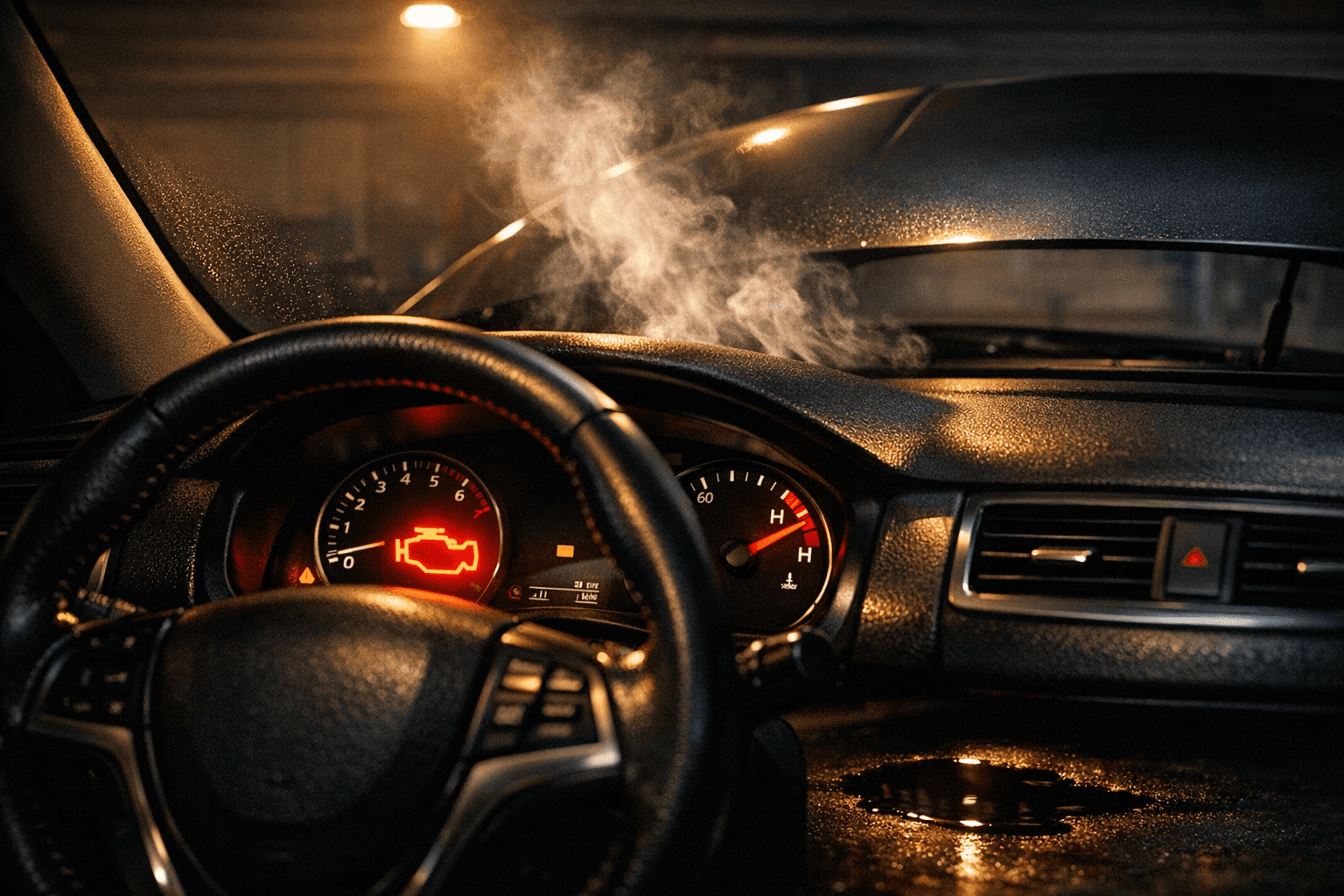
10 Signs Your Engine Needs Immediate Attention
Your car's engine is the core of its performance, and ignoring warning signs can lead to expensive repairs or safety risks. Here are 10 key indicators that your engine might need professional attention:
Check Engine Light: A steady light signals minor issues, while a flashing light indicates severe problems like misfires.
Unusual Noises: Ticking or knocking sounds could mean lubrication issues or internal damage.
Overheating: A rising temperature gauge or warning light could indicate coolant leaks, a stuck thermostat, or oil issues.
Heavy Exhaust Smoke: White, blue, or black smoke often signals coolant leaks, burning oil, or fuel system problems.
Power Loss: Struggling to accelerate or maintain speed might point to issues with air, fuel, or spark delivery.
Rough Idling or Stalling: Erratic RPMs or frequent stalls suggest airflow, fuel, or spark plug problems.
Fluid Leaks: Puddles under your car could be oil, coolant, or transmission fluid escaping due to worn gaskets.
Poor Fuel Economy: Faulty sensors, clogged filters, or misfires can waste fuel and reduce efficiency.
Burning Smell: Odors from oil leaks, worn belts, or electrical shorts may signal serious risks.
Engine Vibrations: Shaking at idle or in motion often points to misfires, vacuum leaks, or failing engine mounts.
Key takeaway: Address these signs promptly to avoid costly repairs or dangerous breakdowns. Regular maintenance and quick action can keep your car running safely and efficiently.
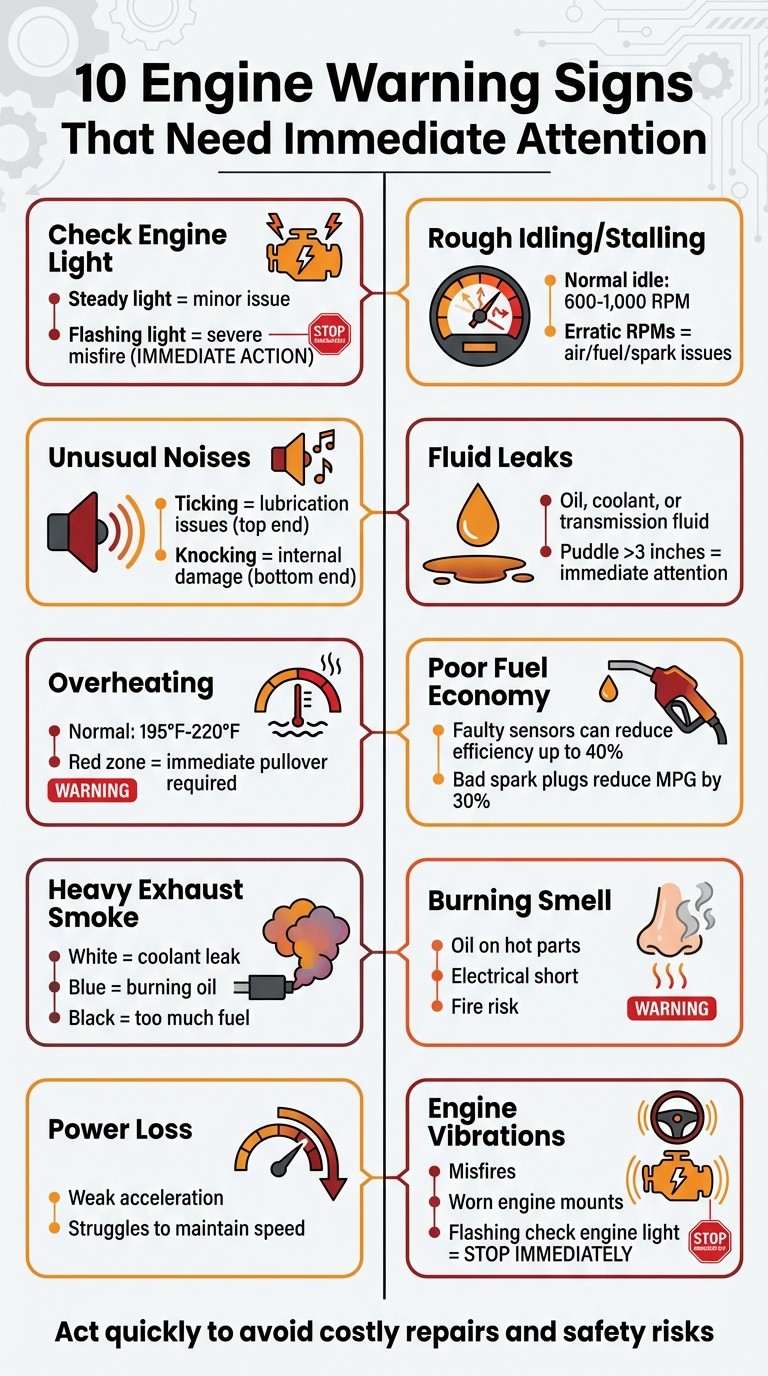
10 Engine Warning Signs That Need Immediate Attention
Every Dashboard Warning Light In Your Car Explained
1. Check Engine Light Turns On
The check engine light is part of your car's onboard diagnostics (OBD) system, which keeps track of things like engine speed, fuel mixture, and ignition timing. When something goes wrong, this light pops on to grab your attention.
The way the light behaves can tell you how serious the problem is. If it’s a steady, solid light, it usually means there’s a minor issue that needs attention soon. However, a flashing light is a red flag - it often signals a severe engine misfire. This can cause unburned fuel to heat up the exhaust system to over 2,000°F, potentially damaging the catalytic converter in just minutes [5].
"A solid check engine light typically indicates a more minor issue, while a flashing light warns of a severe issue that needs immediate attention." – Chase Auto [7]
Some common reasons for the light include a loose gas cap (a quick fix for about $15), faulty oxygen sensors (roughly $175 for the part), worn spark plugs ($10 to $20 each), or a dirty mass airflow sensor ($120 to $150) [4]. Start by checking the gas cap - it might just need tightening until it clicks. This simple step often solves the problem. If the light stays on, it’s time to dig deeper.
To figure out what’s wrong, an OBD-II scanner can be a lifesaver. These handy tools, priced between $40 and $100, can read the trouble codes stored in your car’s computer [4]. This gives you a clearer picture of the issue before heading to a mechanic. If you prefer professional help, diagnostic tests typically cost $50 to $100 [4].
One critical note: if the light is flashing, pull over immediately and turn off the engine. Continuing to drive could lead to costly - and preventable - damage.
2. Knocking or Ticking Sounds
Odd noises from your engine can be unsettling, but understanding them can help you gauge the urgency of the problem. Ticking sounds often come from the top of the engine, where components like lifters and camshafts are located. Knocking, on the other hand, typically points to issues deeper inside, such as with the crankshaft or bearings.
"The ticking is normally indicating something wrong with the top end of the engine, while the knocking indicates internal damage or something wrong with the bottom end." – Magnus Sellén, Certified Automotive Diagnostic Technician [9]
This distinction matters because ticking noises are often linked to lubrication issues, while knocking could signal severe internal damage.
A ticking noise is commonly caused by low oil levels or oil pressure. When oil is insufficient, the top-end parts don’t get the lubrication they need, leading to rapid clicking sounds. Check your oil dipstick immediately - adding oil might solve the problem. For reference, oil pressure should be at least 15–20 psi when the engine is warm and idling [10][11].
However, not all ticking is a cause for alarm. Many modern direct-injection engines produce a normal ticking sound from their fuel injectors. To rule out serious issues, rev the engine to about 2,500 RPM while in park. If the ticking fades, it could be due to a leaking exhaust manifold gasket rather than engine damage [10].
Knocking sounds are a different story. If you hear a deep, metallic banging that gets louder as the engine revs - commonly called "rod knock" - you need to stop driving immediately. This noise points to bearing failure, which can quickly lead to catastrophic engine damage.
"Rod knocking can destroy an engine in minutes. Pull over safely and call for a tow", advises Dustin Rutkowski, Master Technician and Founder of Auto DR [12].
Ignoring this could lead to repair costs that often exceed the value of older vehicles.
3. Engine Runs Too Hot
Overheating is another major warning sign of engine trouble, right up there with unusual sounds. Normally, your engine temperature should stay between 195°F and 220°F [14]. If the temperature gauge starts heading toward the red zone or you see a thermometer-shaped warning light on your dashboard, your engine is already overheating [14].
When this happens, you need to act fast. Start by turning off your air conditioner, then crank up the heater and fan to their highest settings. This might make the cabin uncomfortably warm, but it helps draw excess heat away from the engine. Pull over as soon as it's safe, turn off the engine, and let it cool down for 15–30 minutes [14].
"The steps you take could mean the difference between replacing a $20 thermostat and thousands of dollars in repairs." – Richard Reina, Product Training Director, CARiD.com [16]
Once you've pulled over, wait at least 15–30 minutes before opening the hood. And whatever you do, don’t touch the radiator cap while the engine is still hot. Coolant can reach temperatures over 230°F and may spray out under pressure, causing serious burns [15].
Some common reasons for overheating include low coolant levels (often caused by leaks), a stuck thermostat that blocks coolant flow, or a failed water pump that halts circulation completely [13]. Even low engine oil can play a role since it helps regulate temperature [13]. If you notice a sweet, syrup-like smell, it’s likely a coolant leak. On the other hand, a burning plastic odor could mean seals or valves are failing [14].
4. Heavy Exhaust Smoke
Seeing light vapor from your exhaust on a chilly morning? That’s usually just condensation and nothing to worry about. But thick, persistent smoke? That’s a red flag for internal engine trouble.
Let’s break it down by color:
White smoke that’s thick and refuses to fade is often a sign of coolant leaking into the combustion chamber. If you notice this along with a drop in your coolant level, you might be dealing with a blown head gasket or a cracked engine block [20]. In these cases, driving further could lead to severe engine damage. Automotive journalist Justin Pritchard emphasizes:
"If you suddenly notice a large volume of white vapor from your car's tailpipe, burning engine coolant is the likely cause... Seek a professional assessment immediately. Avoiding driving is advised to prevent further engine damage." [22]
If white smoke isn’t the issue, pay attention to other smoke colors - they each tell a different story.
Blue or blue-gray smoke means oil is burning in your engine. This often happens when worn piston rings or leaking valve seals allow oil to seep into the combustion chamber [19]. If you see this, check your oil level ASAP to prevent further damage. Blue smoke during acceleration might point to damaged piston rings, while smoke during deceleration could indicate worn valve guides [21].
Black smoke is a sign your engine is running too rich - basically, it’s burning more fuel than it should. This can be caused by a clogged air filter, faulty fuel injectors, or malfunctioning sensors [17][20]. A clogged air filter is usually an easy and affordable fix, but if the problem continues, you might notice reduced fuel efficiency and error codes like P0172 or P0175 popping up [20].
Each type of smoke is a clue - don’t ignore it, as it could save you from bigger headaches down the road.
5. Weak Acceleration or Power Loss
When your engine hesitates or struggles to deliver power, it can compromise your ability to merge onto highways or overtake other vehicles safely. This type of issue isn't just frustrating - it can be dangerous.
The root cause often boils down to a problem with air, fuel, or spark. A clogged air filter is one of the quickest checks to make. If it looks dark and packed with debris, replacing it might solve the issue right away[23][25]. On the fuel side, a failing fuel pump that can’t maintain the required 40 to 60 PSI can lead to hesitation, especially during high-demand situations like merging or accelerating hard[25]. Worn-out spark plugs are another common culprit - they might handle idle conditions fine but fail to perform under the higher pressure required for acceleration[23][25].
If these straightforward fixes don’t work, the issue could be more complex. For instance, a clogged catalytic converter can create backpressure, preventing exhaust gases from escaping properly and causing noticeable power loss[23][24]. In more severe cases, internal engine problems like worn piston rings or a blown head gasket might be to blame, especially if the power loss is paired with unusual noises or low compression[24][26].
Sometimes, the problem might not even be with the engine. If your engine’s RPMs increase normally, but your vehicle’s speed doesn’t match, the transmission could be at fault[25][27]. On the other hand, a hissing sound under the hood might point to a vacuum leak, which allows unmetered air into the system and disrupts the air-fuel balance[25].
To start troubleshooting, check your air filter and use a diagnostic scanner to identify any error codes, even if the check engine light isn’t on[25]. If these steps don’t resolve the problem and your car continues to hesitate, stall, or shake violently, it’s time to consult a mechanic. Ignoring these signs could lead to severe damage to the engine or catalytic converter[1][25].
6. Rough Idling or Engine Stalling
Rough idling or stalling can be more than just an inconvenience - it’s a safety concern. If your engine struggles to maintain a steady idle or stalls in traffic, it’s a clear sign something’s wrong. Normally, a healthy engine idles smoothly between 600 and 1,000 RPM. If the tachometer needle jumps around or the car shakes excessively, the engine’s balance is likely being disrupted.
These problems often stem from issues with how air, fuel, or spark reaches the engine. Common culprits include a dirty throttle body, a malfunctioning Idle Air Control (IAC) valve, clogged fuel injectors, a weak fuel pump, or worn-out spark plugs. For reference, copper spark plugs typically last around 30,000 miles, while iridium or platinum ones can last between 60,000 and 100,000 miles [18].
"At idle, your engine runs at its lowest speed - typically between 600 and 1,000 RPM. This is when the engine produces the least power and has the least momentum to smooth over irregularities." - Rohnert Park Transmission [18]
Pay attention to any hissing or whistling sounds from the engine bay, as these often indicate a vacuum leak caused by cracked or loose hoses. Such leaks allow unmetered air into the system, disrupting the air-fuel mixture [18]. Worn engine mounts can also amplify vibrations, especially noticeable when the air conditioning is running [18]. If your check engine light flashes during idle, it may signal a severe misfire. This issue requires immediate attention to avoid damaging the catalytic converter [18].
To diagnose the problem, start by inspecting your air filter and scanning for trouble codes like P0300 or P0101. Air filters should generally be replaced every 15,000 to 30,000 miles [18]. If you notice your RPMs dropping below 600 or the car stalling frequently - particularly in traffic - seek professional help immediately. These symptoms point to serious engine trouble that could worsen if left unchecked [1].
Tackling these idling problems early can save you from more extensive engine repairs down the road.
7. Fluid Leaking Under Your Car
Noticing a puddle under your car? That’s usually a sign of a fluid leak. Since your car’s fluids operate within a sealed system, any leak suggests something isn’t working as it should - often due to an aging gasket that has cracked or hardened over time [32]. These fluids play critical roles in lubrication, cooling, and hydraulic functions, and losing them can result in severe damage - or even pose a fire risk [3].
Identifying the Leak
The first step is figuring out what’s leaking. To do this, park your car over a clean white piece of cardboard, marking the wheel positions to help pinpoint the source [28]. Here’s a quick guide to identifying common automotive fluids:
Engine Oil: Starts off amber but darkens to brown or black as it ages. It feels thick and greasy and may smell like burnt cooking oil [29].
Coolant: Typically comes in bright colors like green, orange, pink, or yellow. It has a sticky, slippery texture and a sweet, syrup-like smell [30].
Transmission Fluid: Bright red or pink when new, turning reddish-brown as it ages. It has a petroleum-like scent and usually leaks near the center of the car [31].
Brake Fluid: Ranges from clear to dark brown, feels extremely slippery, and may have a chemical or fishy odor. You’ll often spot it near the wheels [31].
These characteristics can help you quickly determine what type of fluid is leaking.
"The top cause of serious engine damage is loss of coolant." - RepairPal [31]
When to Act
Not all leaks are equally urgent. A puddle wider than 3 inches calls for immediate professional attention, while smaller spots (1–2 inches) might just be minor seepage. However, any brake fluid or gasoline leak is always an emergency. If you suspect either, avoid driving the car and have it towed immediately [31].
Coolant leaks can lead to overheating, which may warp metal parts of your engine [33]. Oil or fuel dripping onto a hot exhaust manifold could ignite, creating a serious fire hazard [32].
If you notice clear, odorless water under the front passenger side, don’t worry - it’s likely just condensation from your air conditioning system and is harmless [29]. But for genuine leaks, check the fluid levels using your car’s dipsticks or reservoirs to ensure they’re not dangerously low [28]. Avoid using "stop leak" additives; they’re only a temporary patch and can cause long-term damage [29].
If you spot any of these issues, it’s time to act. Getting your car inspected promptly can prevent small problems from becoming big ones. At Hello Motors, we’re here to help keep your vehicle running safely and smoothly.
8. Lower Fuel Economy
If you're stopping at the pump more often than usual, it might be a sign your engine isn't operating efficiently. A noticeable drop in fuel economy often points to your engine burning fuel improperly [1].
One of the biggest offenders? Faulty sensors. For example, a dirty or failing oxygen sensor can send incorrect signals to your engine's computer, causing it to add too much fuel to the mix. Edmunds reports that a dirty oxygen sensor can cut fuel efficiency by up to 40% [37]. Similarly, worn-out spark plugs can lead to misfires, wasting unburnt fuel. According to the National Institute for Automotive Service Excellence, misfires from bad spark plugs can slash fuel economy by 30% [35].
Other potential culprits include clogged fuel injectors, a stuck thermostat that prevents the engine from reaching its optimal operating temperature (185–195°F), or low compression caused by worn piston rings [34][36][37]. Even something as simple as a clogged air filter can force your engine to work harder. In older cars, this could mean burning more fuel, but in newer fuel-injected vehicles, it primarily affects acceleration power [35][37].
To catch these problems early, keep an eye on your MPG manually during fill-ups, as gradual declines might not show up on your dashboard readings [36]. If your fuel economy drops and you notice other signs like the Check Engine light, rough idling, or unusual exhaust smoke, it’s time to visit a mechanic [1][38]. Routine maintenance, such as replacing air filters every 15,000 to 30,000 miles and following your manufacturer’s recommended spark plug replacement schedule (usually around 100,000 miles), can help keep your fuel efficiency in check [35][37].
Ignoring a drop in fuel economy could lead to bigger problems, like damage to your catalytic converter or increased internal engine strain, which can result in expensive repairs down the road [35][24]. Addressing these issues promptly is key to avoiding more serious complications.
9. Burning Smell from the Engine
Strange smells coming from your engine can be a red flag for serious issues, just like unusual exhaust smoke or performance problems. A burning smell, in particular, often points to trouble that shouldn't be ignored. One common cause is leaking engine oil dripping onto hot parts, like the exhaust manifold, which creates an odor similar to hot asphalt. This typically happens when valve cover gaskets, oil pan gaskets, or seals wear out, allowing oil to escape and come into contact with heated components.
"Oil dripping onto hot metal surfaces can pose a real fire risk. Even a small leak that hits the exhaust manifold can smoke, flame up, or melt nearby plastic parts." - AutoZone
Different burning smells can indicate specific problems. A rubbery odor might mean a slipping serpentine belt, while a burning plastic or electrical smell could signal a short in the wiring. If you notice a sweet, syrup-like smell, it’s likely a coolant leak.
"Electrical shorts can damage sensitive components or even lead to fires. If you suspect something electrical is burning, turn off your vehicle immediately and have it towed." - All Around Auto Repair
To prevent these issues, regular inspections are essential. If you notice a burning smell while driving, pull over right away and turn off the engine. Once it cools, check for leaks, low fluid levels, or worn belts. If the smell persists, or if there’s smoke or a rising temperature, it’s safer to have your car towed to a mechanic.
Staying on top of routine maintenance - like checking belts and hoses every 30,000 to 60,000 miles - can catch potential problems before they escalate. Even after fixing a leak, the smell might linger until residual oil is cleaned off by a professional.
10. Engine Vibrations and Shaking
Engine vibrations can offer valuable clues about potential problems, especially when they’re noticeable at idle. While minor vibrations are typical, pronounced shaking felt through the steering wheel or seat often signals something more serious.
One common cause of these vibrations is engine misfires. These can result from worn spark plugs, failing ignition coils, or damaged plug wires. At idle - usually between 600 and 1,000 RPM - the engine’s limited momentum makes it harder to mask such problems. As Rohnert Park Transmission explains:
"At idle, your engine produces the least power and has the least momentum to mask problems. Every imbalance gets amplified" [18].
In addition to misfires, worn engine mounts can allow vibrations to transfer into the cabin. A quick way to test this is by shifting from Park to Drive or Reverse; if the shaking intensifies in gear, it’s a strong indicator of engine mount wear [39][18]. Other potential culprits include vacuum leaks or faulty sensors.
If your Check Engine Light begins flashing during these vibrations, it’s crucial to pull over immediately. A flashing light signals severe misfires, which can cause raw fuel to enter the exhaust system. This can lead to dangerously high temperatures in the catalytic converter - reaching over 2,000°F, far above the normal range of 1,200°F to 1,600°F. Prolonged misfires can melt the converter’s ceramic interior, as noted by the Rohnert Park Transmission Team:
"The ceramic honeycomb inside your converter begins melting within minutes of sustained misfires. Once melted, this material can't be repaired, only replaced" [5].
To address these vibrations, start by checking basic components like the air filter and hose connections. Use a diagnostic scanner to read error codes if the issue continues [3][18]. If vibrations are paired with stalling or power loss, don’t delay seeking professional help - acting quickly can help you avoid turning manageable problems into expensive repairs.
When to Get Professional Help
Warning signs like vibrations, strange noises, or other unusual indicators often mean it’s time to call in the experts. With today’s vehicles relying on advanced computer systems to manage fuel delivery and ignition timing, the old-fashioned tune-up just doesn’t cut it anymore. Instead, specialized diagnostic tools are needed to figure out what’s going on under the hood [8].
A flashing check engine light is a serious alert that requires immediate action. While a steady light might just mean it’s time to schedule a service, a flashing one indicates a severe misfire. Ignoring it can lead to immediate damage to your catalytic converter. Matt Lachowitzer, Owner of Matt's Automotive Service Center, emphasizes this point:
"The check engine light testing isn't a suggestion; it's an urgent call for attention" [1].
If you see the light flashing, pull over safely and turn off your engine right away.
Other warning signs, like loud knocking, grinding noises, or strong gasoline or exhaust odors, shouldn’t be ignored either. These could signal major internal problems, such as failing bearings or pistons, or even dangerous leaks that could expose you to carbon monoxide. These are not issues you can fix yourself - professional mechanics use advanced tools to figure out whether it’s something minor, like a sensor issue, or a major internal failure that might require significant repairs.
Before heading to a professional, you can do some basic checks yourself and keep track of when the symptoms occur. This information can help mechanics diagnose the problem faster.
If the cost of repairs equals 50% or more of your car’s market value, it might make more sense to replace the vehicle instead. Major repairs, such as fixing a seized engine (often $3,000 or more) or replacing a hydrolocked engine (upwards of $5,000), can quickly surpass this threshold [40]. In situations like these, Hello Motors offers flexible financing options to help you find a reliable replacement vehicle.
Conclusion
Engine warning signs shouldn’t be ignored - they call for immediate attention to avoid expensive repairs down the line. Something as simple as a loose gas cap or a worn spark plug might cost just a few dollars now, but delaying those fixes could lead to catastrophic engine failure [41].
These issues don't just affect your car's performance - they can put your safety at risk. Engine trouble can create dangerous scenarios, like stalling in traffic or losing power while merging onto a highway [2]. Beyond the risk of accidents, ignoring these signs could expose you to serious hazards like carbon monoxide poisoning from exhaust leaks or even engine fires [3].
Stay proactive by regularly checking your oil and coolant levels, and don’t ignore unusual sounds [3]. If your temperature gauge spikes or the check engine light flashes, pull over immediately to prevent severe damage [6].
As emphasized throughout this guide, addressing problems early keeps your engine in good shape and prevents them from escalating into dangerous situations. As Parts Matter puts it:
"Taking action when the light first comes on can mean the difference between catching something before it becomes a major problem and being stranded on the side of the road" [8].
By acting quickly, you not only avoid the stress of breakdowns but also protect your investment and ensure the safety of everyone in your vehicle. Your engine’s lifespan depends on how well you maintain it [2]. Don’t wait - address warning signs promptly to keep your engine running smoothly and safely.
For more expert vehicle maintenance tips, visit the Hello Motors blog.